
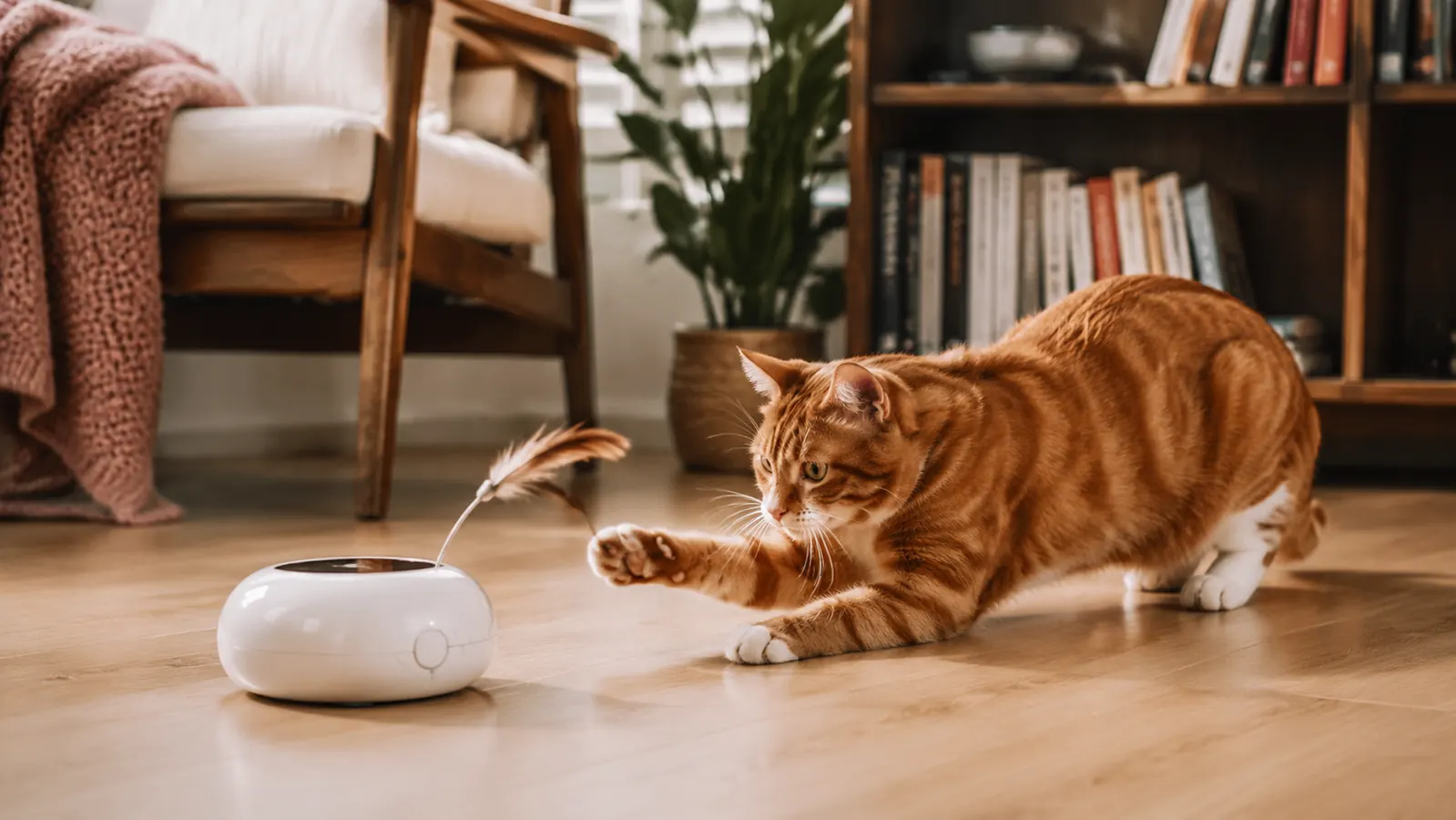
I bought the Petstages Tower of Tracks before I even had Marigold trained to the name. It was the first toy I reached for at the pet store, the one on every 'starter kit' list, the one every new cat owner seems to end up with. Marigold sniffed it, batted a ball once, and walked to the window. Pip, who arrived four years ago as a tornado in a carrier, spent about two afternoons on it before losing interest entirely. The tower has been sitting in the corner since.
When the ORSDA 4-in-1 interactive toy showed up, I expected the same arc. A week of excitement followed by a furniture ornament. Eight months later it is still part of Pip's daily routine, and Marigold, who I genuinely thought was past caring about toys, still perks up when the wand mode starts moving. That gap in sustained engagement is what this comparison is really about. It is not just ORSDA vs Petstages. It is automatic vs passive, and which approach actually fits real cats in real homes.
| Feature | ORSDA 4-in-1 Cat Toy | Petstages Tower of Tracks |
|---|---|---|
| Play type | Active, automated motion | Passive, cat-initiated |
| Modes | 4 (Whack-a-Mole, Hide and Seek, Magic Wand, Chase Teaser) | 1 (spinning track balls) |
| Power source | Rechargeable USB-C | No power needed |
| Approximate price | Around $32 | Around $14 |
| Setup time | 2 minutes | 30 seconds |
| Noise level | Low hum + occasional feather flutter | Silent |
| Solo-play capable | Yes, fully autonomous | Yes, but requires cat motivation |
| Engagement style | Prey simulation, unpredictable movement | Tactile batting, predictable loop |
| Best for | Active hunters, easily bored cats, busy households | Kittens, casual batters, supervised sessions |
| Replacement parts needed | Feathers periodically | Balls rarely need replacing |
Where the ORSDA 4-in-1 Wins
The ORSDA's real advantage is that it does not need you in the room to work. That sounds like a small thing until you realize most of us are away for eight or nine hours a day and our cats are bored out of their minds by 10 a.m. The four modes give the toy enough variation that cats do not fully pattern-learn it the way they do with simpler toys. Pip, who is a very smart and very destructive four-year-old when he has nothing to do, has been running through the wand and chase modes without my involvement since roughly October. He has torn up exactly zero houseplants since I started using it on a timer.
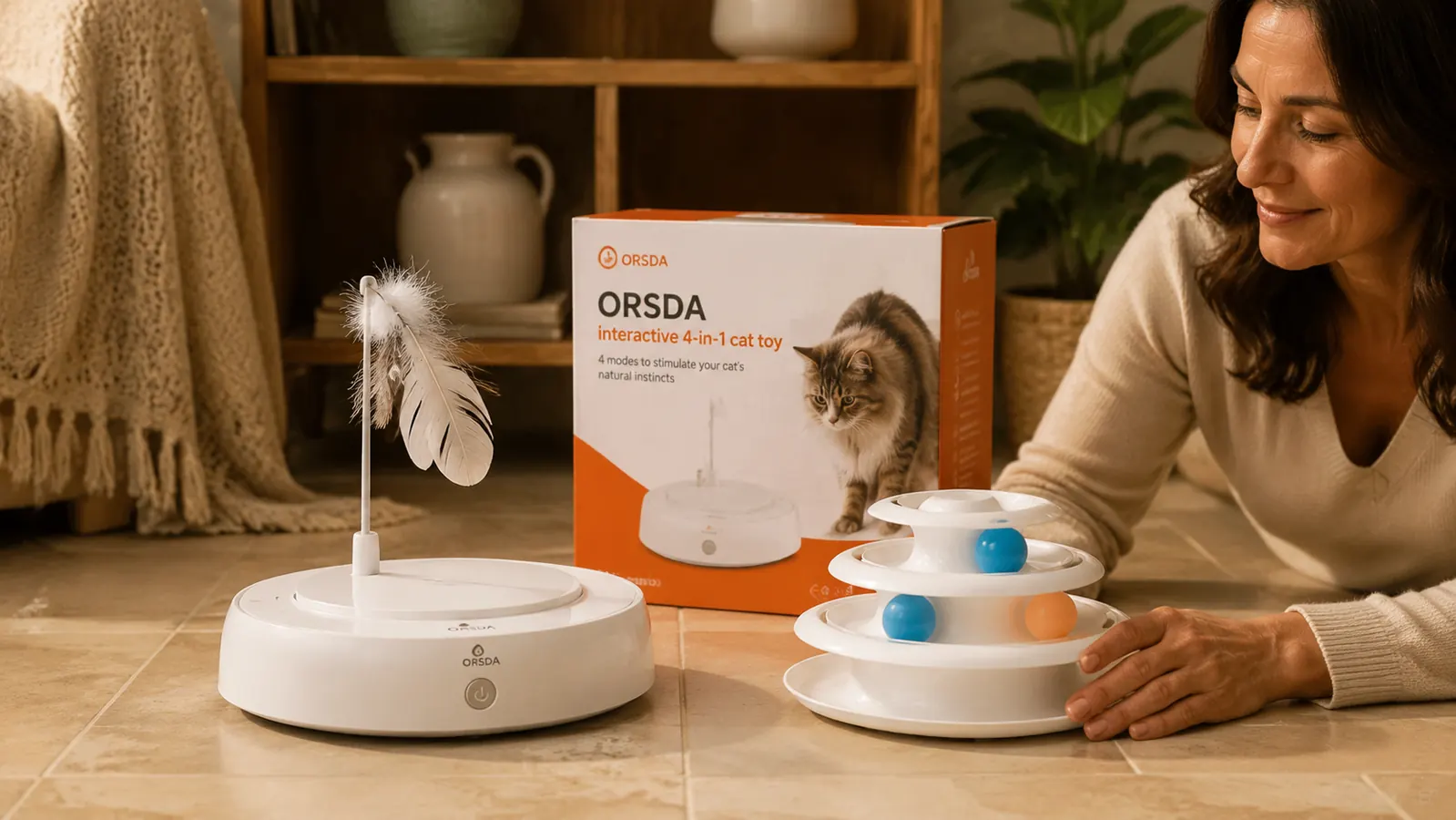
The build holds up better than I expected too. The motor is still quiet after months of daily use, the USB-C charge lasts a solid two to three weeks at moderate use, and the only recurring cost is feather replacements every few months, which run a few dollars. For a toy at this price, that longevity is not common. Most cheap automatic cat toys I have tried are loud, stop working within weeks, or have a single jerky movement pattern cats dismiss after day two. The ORSDA moves more naturally, especially in wand mode, which does a convincing enough prey arc to keep even Marigold, a nine-year-old who normally looks at toys with polite disinterest, coming back.
The touch sensor is also genuinely useful. Pip figures out buttons fast and has learned he can turn the toy on by tapping the center. Whether that is clever or just a happy accident, the result is that he uses the toy on his own schedule, not just when I remember to turn it on. That kind of self-directed play is exactly what enrichment for indoor cats should look like.
Your cat is home alone for eight hours. Give them something that actually moves.
The ORSDA 4-in-1 runs four different play modes automatically, charges via USB-C, and keeps cats occupied without needing you in the room. Rated 4.5 stars across more than 2,300 reviews.
Amazon Check Today's Price on Amazon →Where the Petstages Tower of Tracks Wins
I want to be fair here because the Tower of Tracks genuinely has a use case and I do not think it is a bad product. It is just a different product for a different situation. For kittens and young cats who are still figuring out their paws, the track ball format is a solid tactile learning toy. There is something satisfying about a ball that keeps moving when you bat it, and for a ten-dollar toy with zero setup, it earns its place in a play rotation, especially for supervised play when you have time to sit with the cat and make it interesting.
The Tower also wins on simplicity. No charging, no moving parts to break, no noise at 2 a.m. if your cat decides midnight is play time. For cats who are noise-sensitive or easily startled, a completely silent toy is a real consideration. Marigold went through a stretch after her crystals diagnosis in 2024 where any unexpected sound sent her bolting, and during that period I was glad to have low-stimulation options. The Tower of Tracks is exactly that.
Pip learned to turn the ORSDA on by tapping the sensor. At that point it stopped being a toy I operated for him and became a toy he used on his own schedule. That is the whole point of enrichment.
The Sustained Engagement Problem
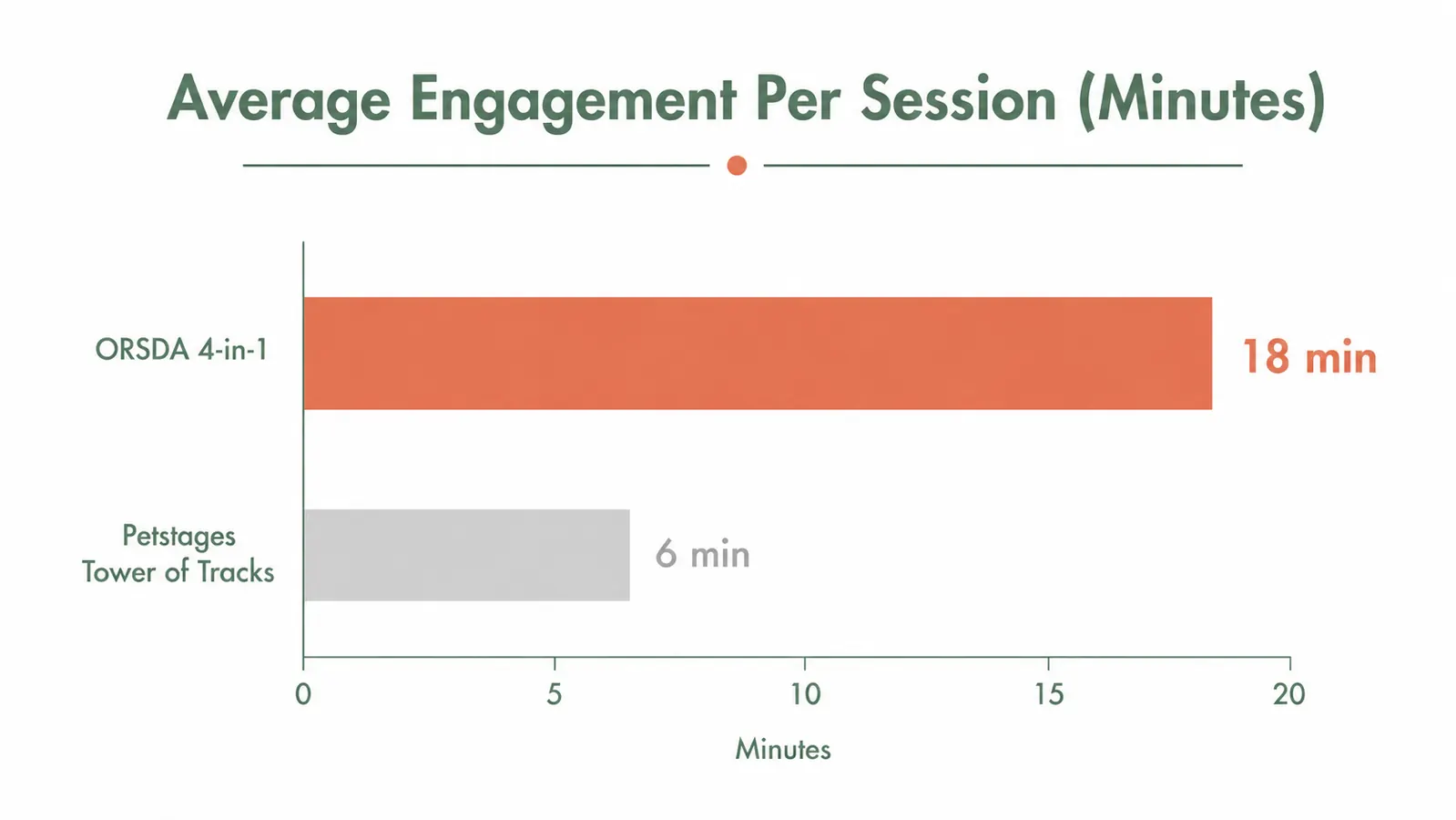
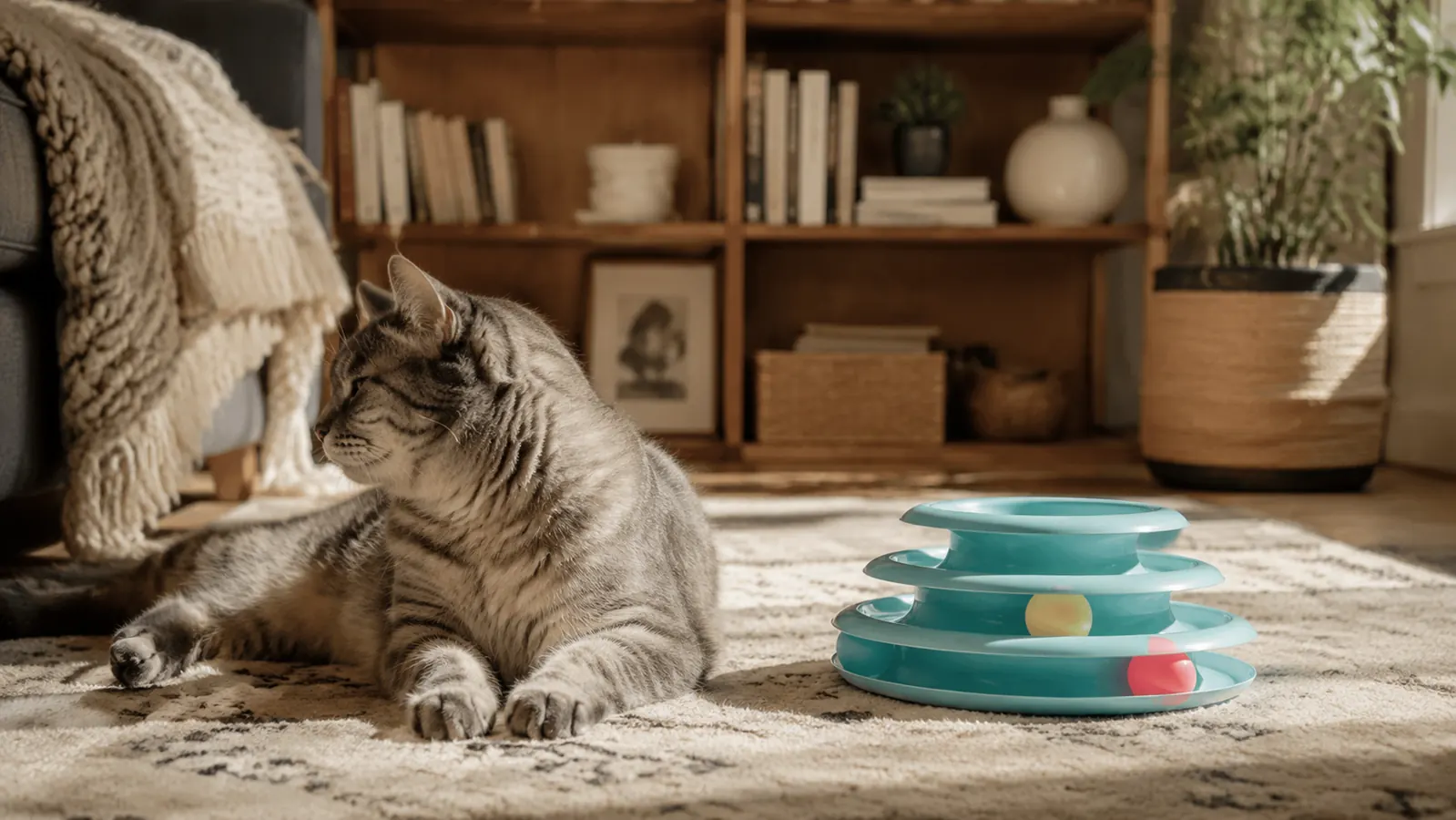
Here is what matters most when you are comparing these two formats: how long does the cat stay engaged, session over session, week over week. I paid attention to this for a solid month with both toys, watching Marigold and Pip across a range of sessions and moods. The Tower of Tracks peaked in its first week. By week three, neither cat would approach it unless I was sitting next to it rolling a ball manually. Left alone, it produced zero interaction after the initial novelty wore off.
The ORSDA showed a different pattern. Engagement dipped a bit after the first two weeks, which is normal, then stabilized. Months later, with regular use, both cats still engage for meaningful stretches. I would estimate Pip averages fifteen to twenty minutes of real active play per session on the ORSDA. On the Tower, unprompted, it was closer to two or three minutes by month two. For a cat who needs real mental and physical stimulation to stay out of trouble, that difference is not trivial.
Setup, Noise, and Day-to-Day Practicality
The Tower of Tracks sets up in thirty seconds and stays set up. Nothing to charge, nothing to switch on or off. If you want zero friction, it wins on that dimension. The ORSDA takes maybe two minutes the first time you put it together, and after that setup is done. Charging takes a few hours and lasts weeks. The slight hum of the motor and the feather flutter are the only sounds it makes, neither loud enough to be a problem in a normal living space. My downstairs neighbors have never mentioned it, which is the real test.
One practical note: the ORSDA's wand can get overly enthusiastic if you have the speed set too high for a senior cat. Marigold does better on the lower speed settings where the movement is slower and more deliberate. Pip lives on full speed. Having that adjustment range is something the Tower of Tracks simply cannot offer.
Who Should Buy the ORSDA
If you have an active cat between one and eight years old who gets bored fast, gets into things when bored, or is left alone for most of the day, the ORSDA is the right call. It is also worth it if you have tried passive toys and watched them sit untouched after the first week. The autonomous operation is what sets it apart. You do not have to remember to play with the toy, it handles that. At around $32, it is not a throwaway purchase, but it is substantially cheaper than replacing chewed baseboards or knocked-over plants.
Multi-cat households also benefit specifically from the automatic modes because the toy keeps running even when neither cat is currently engaged. It has a way of pulling a second cat into the room who was not paying attention, which generates a whole separate social play dynamic that is genuinely entertaining to watch.
Who Should Buy the Petstages Tower of Tracks Instead
Get the Tower if you have a kitten under six months and want a tactile starter toy. Get it if your cat is noise-sensitive and easily stressed by moving objects. Get it as a budget supplement to a primary toy rotation, not as the anchor. And if you are buying for a cat who is genuinely ball-obsessed, some cats just love batting at contained rolling objects, it may be the better fit regardless of the price difference. I would not recommend it as a standalone enrichment solution for a healthy adult indoor cat with no other stimulation, but as part of a varied toy environment it earns a spot on the floor.
Eight months in, the ORSDA is still the toy Pip picks first every day.
Four play modes, touch-activated sensor, rechargeable battery, and a movement pattern complex enough to hold a cat's attention past week one. Read the full review or check the current price directly.
Amazon Check Today's Price on Amazon →