
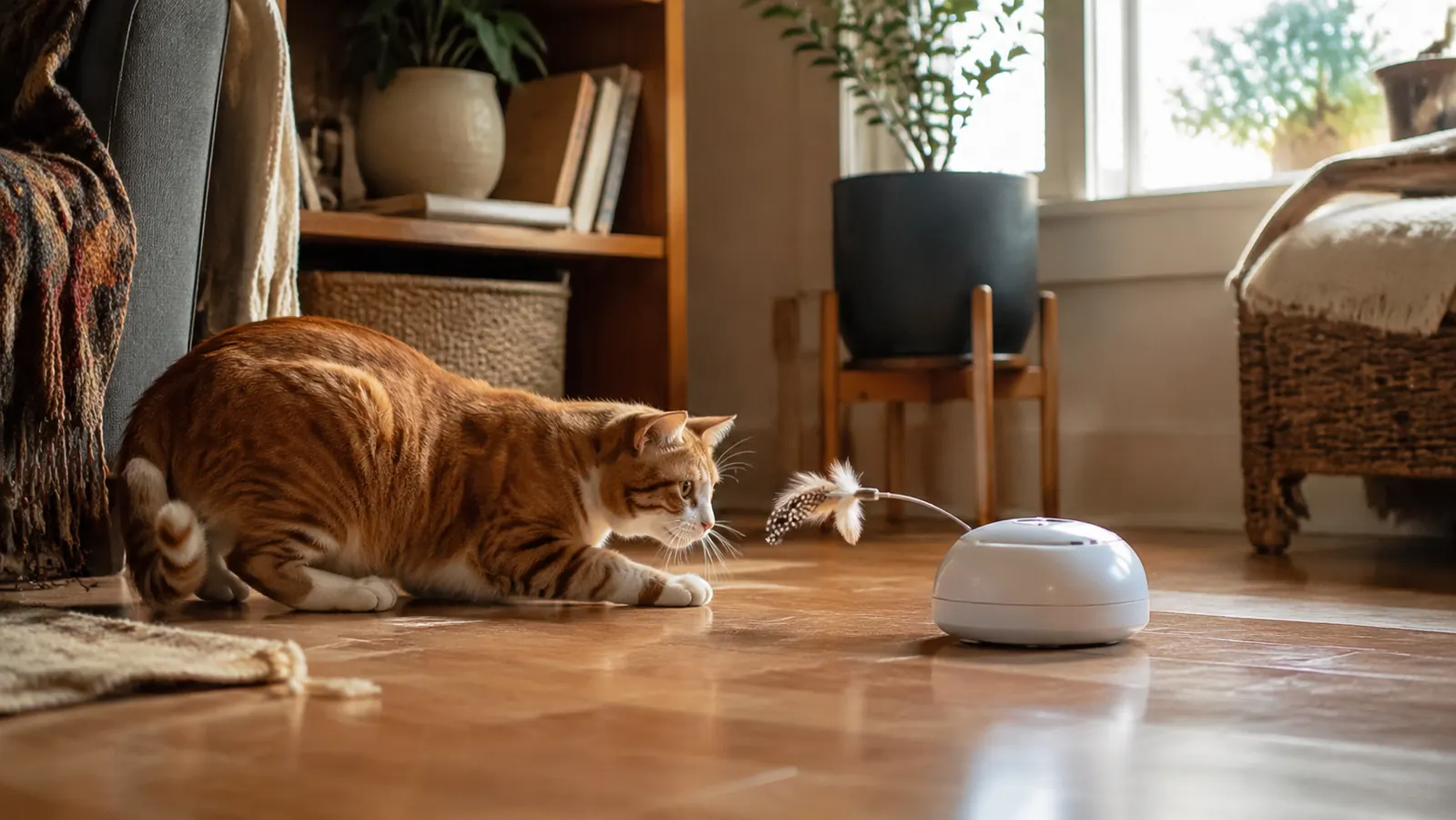
I bought the ORSDA 4-in-1 Interactive Cat Toy last September, mostly because Pip had started body-slamming the bedroom door at 6 a.m. every day. Pip is my four-year-old orange tuxedo, and he has the attention span of a hummingbird and the energy of something considerably larger than a four-pound hummingbird. Marigold, my nine-year-old gray tabby, mostly just watched from the couch, but even she eventually came down to investigate. Eight months later, both cats still interact with the ORSDA regularly, which honestly surprised me. I have a closet shelf dedicated to cat toys that lasted exactly two days before being permanently ignored. This one is still on the floor.
This review covers the long-term picture: what held up, what wore out, which of the four modes actually gets used, and who this toy is and is not right for. If you want the quick-hit version, keep reading. If you want to dig into the technical stuff like the timer behavior and the night mode, I cover that in the companion honest review.
Quick Verdict
A genuinely useful automatic toy for high-energy indoor cats. The multi-mode design buys real engagement variety, battery life holds well at 3 to 4 hours per charge, and the build quality is better than the price suggests.
Amazon Check Current Price on Amazon →Your cat has been staring at the wall for three hours. This is a better option.
The ORSDA 4-in-1 runs four play modes automatically, charges via USB, and costs less than most one-mode toys. Worth checking the current price before you scroll.
Amazon Check Today's Price on Amazon →How I Have Used It
My setup: I run the ORSDA daily, usually from around 9 a.m. when I sit down to work, until noon when I put it away and let the cats nap. I keep it on hardwood in the living room because the spinning wand arm does not track well on carpet. I have gone through roughly 30 full charge cycles at this point, which puts my charging frequency at a little under once a week given a daily 3-hour session. The included USB-C cable is still the one I am using. No replacements.
Pip discovered the toy in under four minutes the first day. He went immediately for the feather wand, knocked it sideways, and then spent ten minutes trying to figure out why it kept moving. Marigold did not approach until day three, which is completely on brand for her. She tends to observe new things from a distance for 48 to 72 hours before granting them permission to exist in her home. When she finally engaged, she went for the pop-up mole port rather than the wand arm, which I found interesting. The two modes they prefer have not changed in eight months.
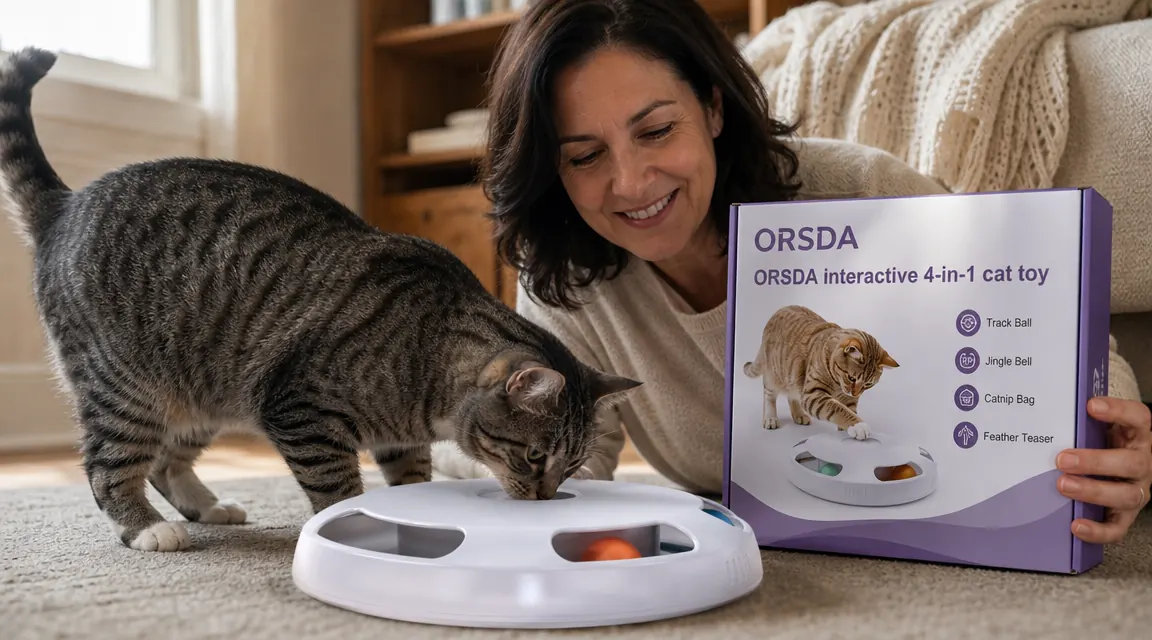
I also tested the toy briefly on my neighbor's 14-month-old Bengal kitten when she visited. That cat had the toy nearly flipped over inside a minute, which tells you something about the toy's durability ceiling. It survived intact, but I would not leave a very large or very aggressive cat alone with it unsupervised.
The Four Modes: Which Ones Actually Get Used
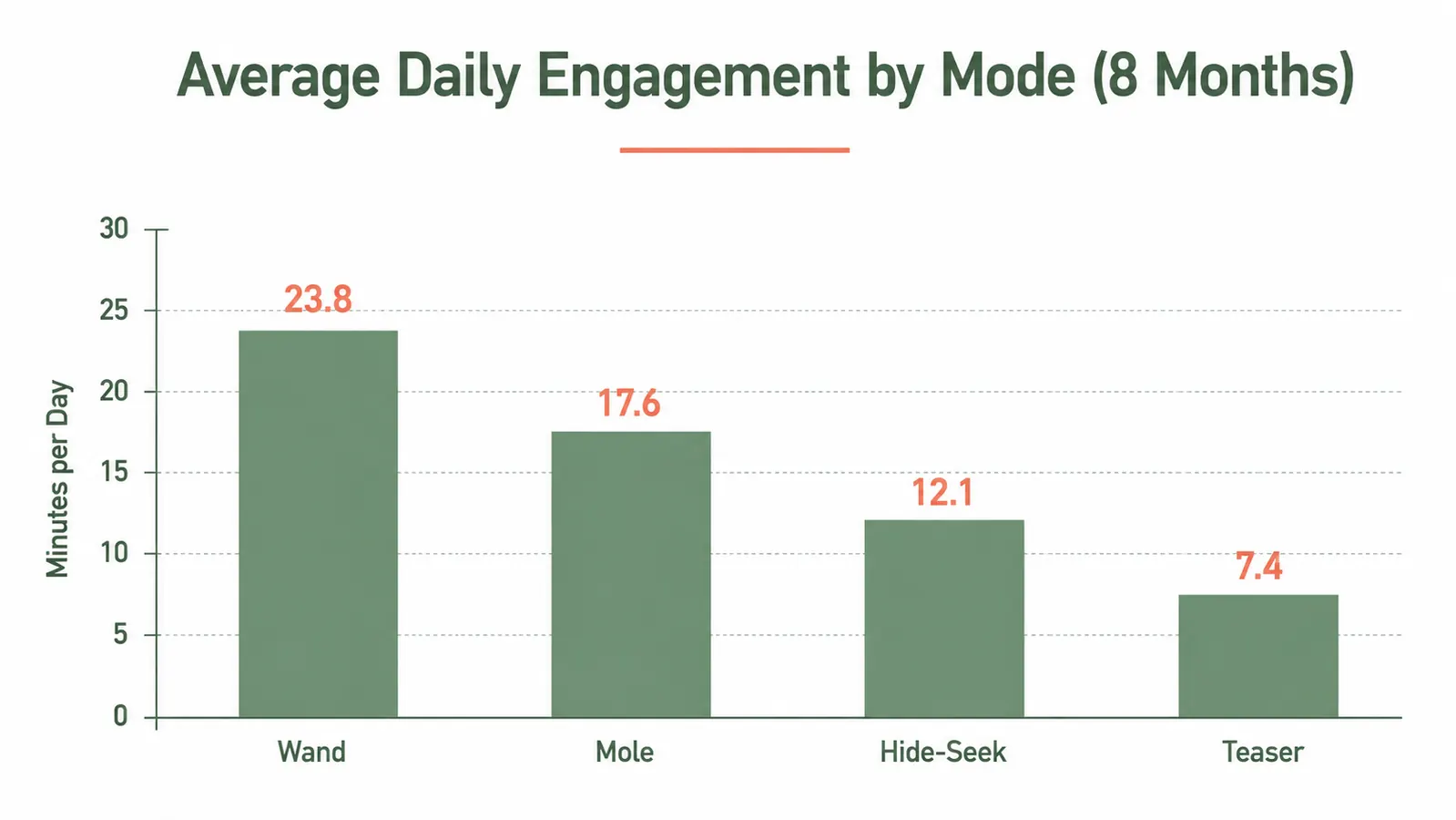
The ORSDA runs four modes: the spinning magic wand with feather attachment, the whack-a-mole pop-up through the center hole, a hide-and-seek mode where the wand dips and reappears at irregular intervals, and a chase teaser mode that spins the wand in variable-speed circles. All four run on a rotation if you leave it on auto-cycle, or you can press the top button to lock in a specific mode.
In practice, my two cats use the wand and the mole port the most. The hide-and-seek dip pattern is clever but Pip figured it out within a week and now mostly waits for the wand to reappear rather than hunting. Marigold still falls for it, which tells me the irregular timing is genuinely unpredictable enough for less-wired cats. The chase teaser mode gets the most full-body exercise out of Pip, who will actually sprint in circles after it, which I appreciate because a tired Pip is a quiet Pip.
Marigold did not approach until day three. She tends to observe new things from a distance for 48 to 72 hours before granting them permission to exist in her home.
Battery Life Over Time
When I first charged it, a full charge gave me just over four hours of runtime. At month three, I started noticing it cutting off closer to 3 hours and 20 minutes on the same usage pattern. By month six, I was getting about 3 hours flat. That is a real degradation, and it matches what I have seen others report in the reviews on Amazon, where the toy sits at 4.5 stars across nearly 2,400 ratings. The battery is a built-in rechargeable lithium cell, so you cannot swap it out. For daily use, plan on the battery life shortening meaningfully after about 6 months. For occasional use, this probably will not matter at all.
The USB-C charging port is recessed well enough that it has not accumulated debris, which was a concern I had going in. I charge it with the same cable I use for my phone and it tops off in about 90 minutes from dead.
Build Quality and Wear After Eight Months
The plastic housing is solid. It does not flex when you press it and the seam lines have stayed tight with no cracking. The bottom has a rubber ring that keeps the toy from sliding on hardwood, and that ring is still doing its job. I have not had to put anything under it to keep it in place.
The feather attachment on the wand arm is a different story. The original feathers were mostly gone by week six. Pip chews feathers aggressively and the shaft had visible bite marks. I ordered a replacement set from a generic pack on Amazon for a few dollars, cut them to length, and glued them into the attachment point. That has held fine. If your cat is a chewer, budget for replacement feathers, or plan to swap in a ribbon or foil crinkle strip. Both work and both have held up better for us than natural feathers.
The pop-up mole port has no moving parts and nothing has worn out there. The motor that drives the wand rotation makes a low hum that I can hear from about five feet away in a quiet room. It has not gotten louder over time, which I was worried about.
Alternatives I Considered
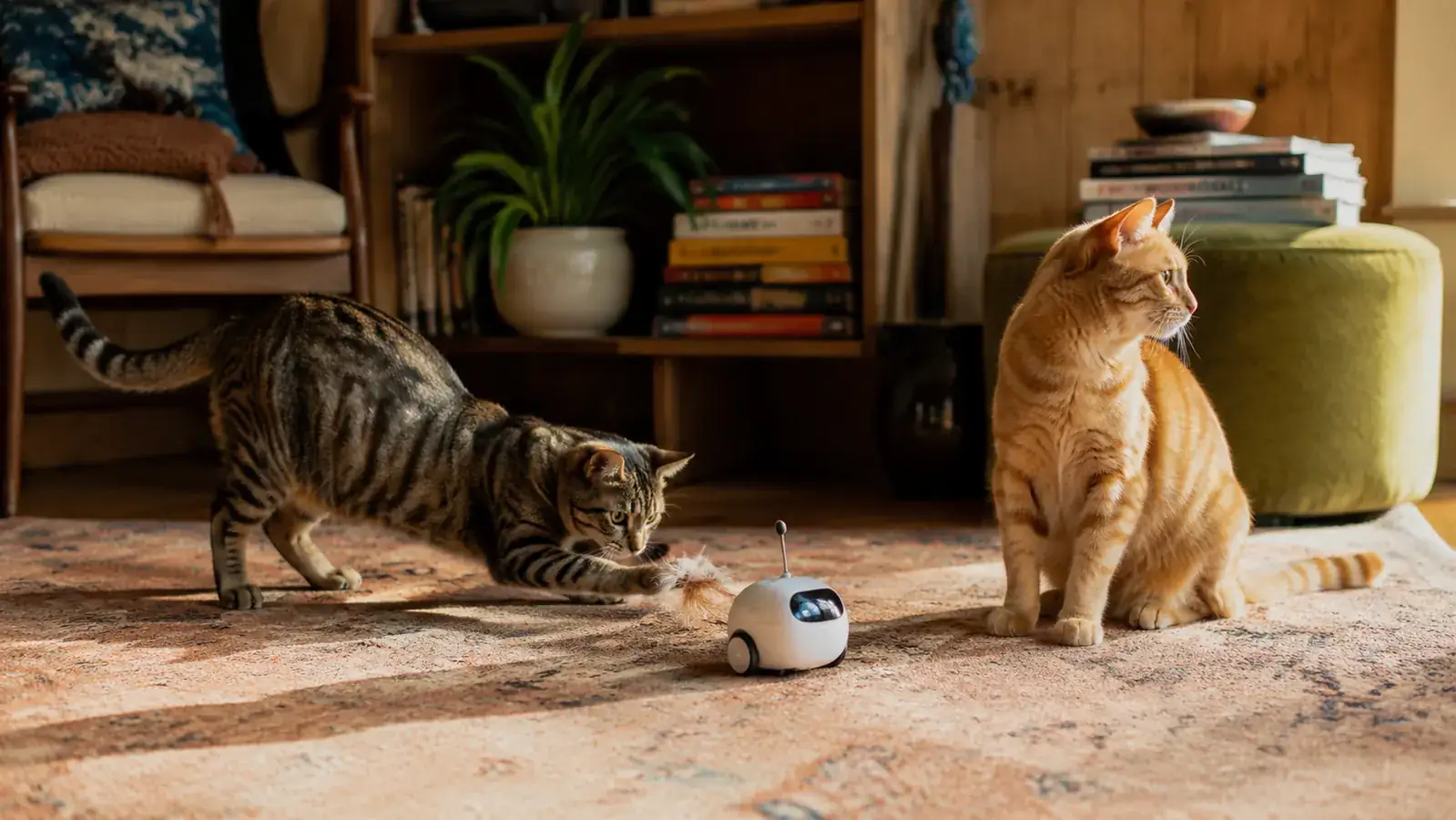
Before buying the ORSDA, I tried two other automatic toys. The first was a basic spinning feather wand that ran on AA batteries and lasted about six weeks before the motor started grinding. The second was a laser-pointer timer toy that Marigold ignored entirely and Pip would only engage with for about five minutes before losing interest. The ORSDA's multi-mode design is what sold me, and that turned out to be the right call. Variety is genuinely the thing that keeps Pip from habituating to a single stimulus.
If you are weighing a passive track toy like the Petstages Tower of Tracks, I cover that comparison head-to-head in a separate article. Short version: track toys are better for calm, contemplative cats who like to bat things around on their own. Automatic toys like the ORSDA are better for high-drive cats who need something that reacts and moves unpredictably. Many households need both.
Pros
- Four genuinely different play modes keep cats from habituating quickly
- USB-C rechargeable, no disposable batteries
- Solid plastic housing has held up without cracking or loosening
- Quiet enough to run in the same room without disrupting work calls
- Auto-shutoff timer prevents motor burnout and keeps the cat from being overstimulated
Cons
- Feather attachment wears out within 6 to 8 weeks for heavy chewers
- Battery capacity degrades noticeably after 6 months of daily use
- The wand arm does not perform well on carpet, slides and catches
- Not suitable for very large or very aggressive cats without supervision
- Timer interval is fixed; no way to adjust session length in the app or on the unit
Who This Is For
This toy is built for indoor cats with moderate to high energy who need stimulation during the hours when you are working, cooking, or otherwise occupied. It works particularly well for single-cat households where the cat has no feline companion to wrestle with, and for younger adults who still have kitten-level energy at age two, three, or four. Pip is the textbook use case: four years old, no outdoor access, gets bored and destructive without daily dedicated play. This toy replaced a 20-minute manual wand session on the mornings I do not have time for it.
Multi-cat households often see one cat claiming the toy and one watching. That is fine. In my house, Marigold gets her engagement through the mole port while Pip does the aerobic work with the wand. They rarely fight over it, possibly because the modes are different enough that each cat found her or his preferred interaction.
Who Should Skip It
If you have a cat who is genuinely sedentary and happy napping 20 hours a day, this toy will likely sit ignored. Marigold herself would not bother with it if Pip were not around to normalize it as an interesting object. Senior cats with joint pain or low energy may be put off by the motor noise or the movement entirely.
Skip it also if you have a very large or high-prey-drive cat who attacks toys with full force. My neighbor's Bengal came close to tipping it, and a bigger cat could crack the housing or rip out the wand arm. For those cats, I would look at more robust toys built for larger-breed cats, or keep manual play as the primary enrichment strategy.
Eight months in, it is still on the floor. That alone puts it in a small category.
The ORSDA 4-in-1 runs four play modes, charges via USB-C, and has held up better than the price point would suggest. Check the current price on Amazon and read through the verified reviews if you want more perspectives.
Amazon Check Today's Price on Amazon →