The tool I rely on most is the ORSDA 4-in-1 interactive cat toy, a rechargeable motion gadget I will walk through how to use below. Disclosure: This article contains Amazon affiliate links. If you buy through them, I earn a small commission at no extra cost to you. I only recommend products I have tested with my own cats.
My orange tuxedo Pip is four years old and has the energy budget of a cat twice his age and half his size. For the first year I had him, I would come home to find a knocked-over plant, a shredded toilet paper roll, and Pip sitting in the middle of the damage looking personally offended that I had taken so long. My 9-year-old gray tabby Marigold mostly just watched. But Pip was a problem I needed to solve before he turned his attention to my curtains.
Indoor cats spend between 12 and 16 hours sleeping, which sounds like a lot until you do the math: that leaves eight to twelve hours of waking time when you are gone. A cat with nothing to do will find something to do. The answer is not one expensive toy you set out on Monday morning. The answer is a system, set up in layers, that runs while you are gone. Here is how I built mine, and what actually works for both a high-drive cat like Pip and a low-key, senior cat like Marigold.
Your cat is home alone right now planning its next disaster. Here is the tool that buys you peace of mind.
The ORSDA 4-in-1 Interactive Cat Toy runs four play modes automatically, has a built-in timer, and recharges via USB-C. It is the anchor of the enrichment setup I describe in this guide.
Amazon Check Today's Price on Amazon →Step 1: Take a 10-Minute Audit of Your Home Before You Buy Anything
Before buying a single toy, walk through your home like a bored cat would. Look for what your cat already gravitates toward. Pip is drawn to anything that moves in a window. Marigold wants height and warmth. Your cat's existing preferences are the blueprint for where enrichment will land versus where it will collect dust.
Identify three to five spots in your home that get natural light, have a clear sightline to something interesting (outside, a hallway, a bird feeder), or already show signs of cat use (fur, claw marks, warm patches on furniture). Those are your enrichment anchor points. Write them down. Everything in the following steps gets placed at or near those spots.
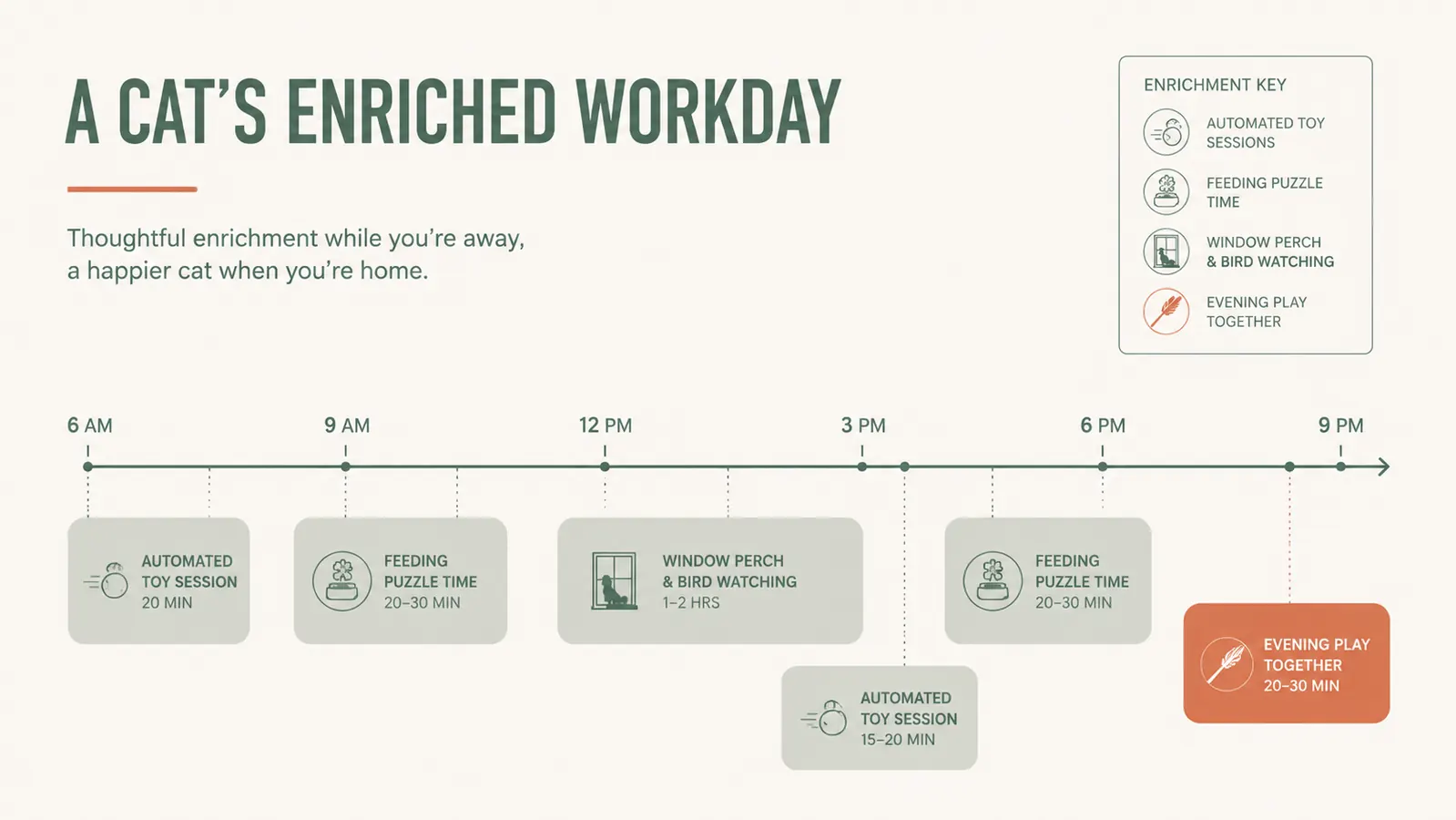
Also count how many waking hours your cat is actually alone. A typical workday for me is about 9.5 hours away from the house. That is the window I need to fill, and I budget roughly one distinct enrichment opportunity per 90 minutes of alone time. That comes out to about six to seven different things to investigate across the day.
Step 2: Set Up at Least One Window Station With Something Worth Watching
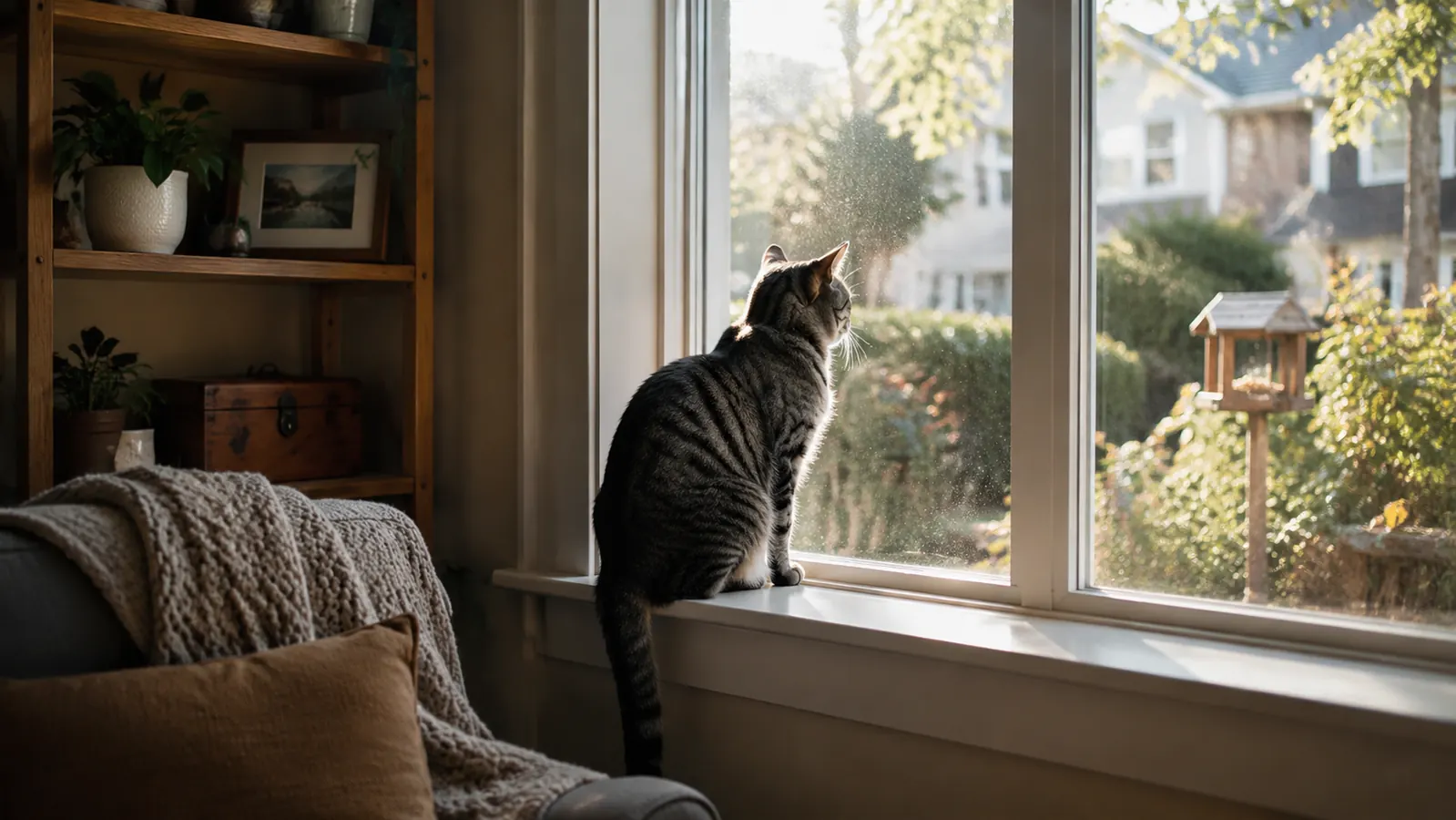
A window perch costs almost nothing and delivers more cat-hours of entertainment than most toys. The key is not just the perch itself but what is outside. If your window looks out at a blank wall, a bird feeder mounted on the glass changes everything. I put a suction-cup feeder on the window Pip claims most often, and within a week he had a morning routine that did not involve my bookshelf.
For the perch itself, you need something stable enough that a cat who jumps from across the room will not tip it. Hammock-style suction perches work well for smaller cats. Marigold, at 11 pounds, needed a freestanding window shelf with a bracket. Either way, put a small piece of fleece or an old sweater on it. The familiar scent keeps cats coming back even when nothing interesting is happening outside.
Step 3: Add an Automatic Toy That Can Run a Scheduled Session Without You
This is the step where a lot of cat owners get stuck. They buy a toy, the cat plays with it for three days, and then ignores it permanently. The fix is two things: novelty and timing. An automatic toy that runs on a schedule activates that same hunting instinct that makes cats reactive to unexpected movement. When the toy turns on at 10 a.m. and your cat was sitting quietly, the surprise element matters.
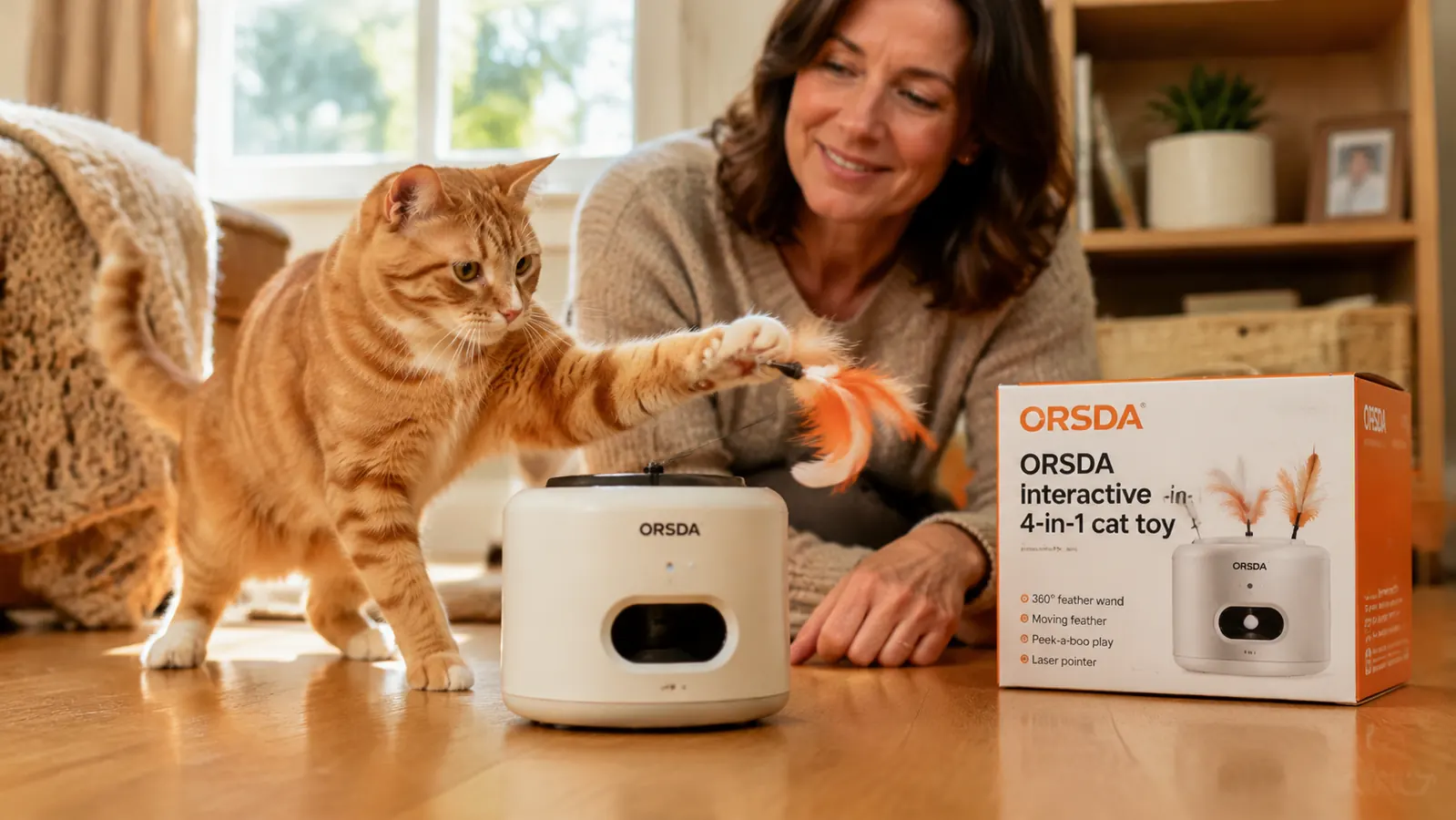
The ORSDA 4-in-1 Interactive Cat Toy is the one I use and recommend because it handles the four different stimulation types that keep cats interested. The Whack-a-Mole mode pops a feather up through holes in a covered base, which is different enough from a standard wand that even a toy-jaded cat will investigate. The hide-and-seek mode runs slower and suits Marigold on her low-energy days. The moving magic wand mode and the teaser chaser give Pip enough chase stimulus that he runs laps around it for a solid ten minutes before settling down. The USB-C rechargeable battery holds a charge long enough that I plug it in every few days, not every day.
Placement matters as much as the toy itself. I put it on the floor in the main living room, not in a corner. Cats like to approach from multiple angles and a corner approach cuts that off. I also rotate which mode is active when I leave in the morning, so Pip does not memorize the pattern.
When the ORSDA turns on at 10 a.m. while Pip is sitting quietly on the couch, the surprise of it is half the point. Cats hunt what moves unexpectedly. A toy that just sits there waiting for a cat to approach it is missing the whole mechanism.
Step 4: Replace One Meal With a Food Puzzle or Scatter Feed
Food is the most reliable motivator for almost every cat, and using it as enrichment instead of just nutrition is one of the highest-leverage changes you can make. A food puzzle makes a cat work for 15 to 25 minutes on something that would normally take 90 seconds from a bowl. That is cognitive effort that produces a genuinely tired cat.
You do not need to buy a dedicated puzzle on day one. A muffin tin with kibble dropped in some of the cups, covered by tennis balls, works fine for beginners. A cardboard egg carton with the lid taped partially shut is another option. I started both Marigold and Pip on the muffin tin setup before I invested in a proper puzzle feeder. The goal is to make eating take effort, not to buy a specific product.
If your cat free-feeds, pull the free-feed bowl for the day and switch to two scheduled portions, one puzzle in the morning and one in a regular bowl in the evening. Cats adapt quickly, and the morning puzzle becomes something they look forward to rather than stress about.
Step 5: Build a Rotation System So Nothing Gets Stale
The single biggest mistake I made early on was leaving the same toys out every day. Cats habituate fast. A toy that got intense attention on Tuesday can be completely invisible by Friday. Rotation is the solution, and it costs nothing.
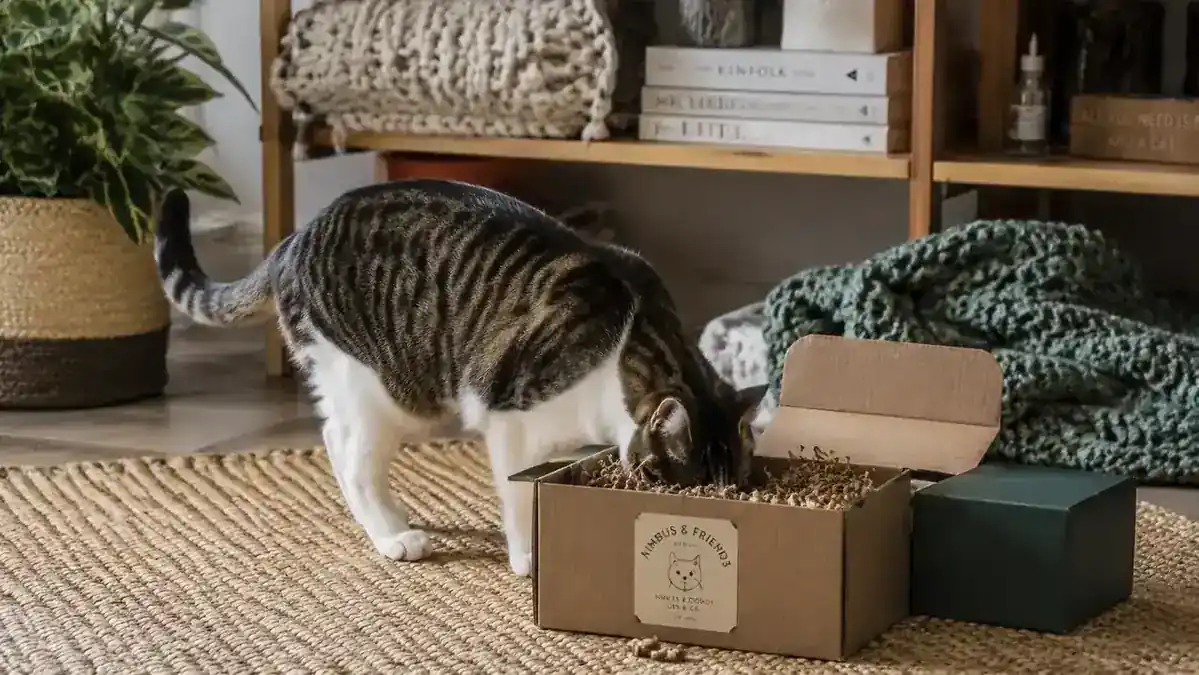
I keep a small bin in the hall closet with toys that are currently on rotation out. Every two to three days, I pull two toys from the main floor and put them in the bin, then swap two different toys back out. When a toy comes back from the bin, it is novel again. I have toys Pip has owned for two years that he still chases hard because they spend most of their time in the closet. The ORSDA toy gets a permanent spot because the mode-switching does the novelty work for me, but everything else rotates.
You can also rotate the location of things. Moving the puzzle feeder to a different room, or moving the window perch from the living room window to the bedroom window for a week, resets a cat's interest. Cats notice environmental changes and investigate them. Use that.
What Else Helps When You Are Gone a Full Day
A few things that do not fit neatly into the step structure above but make a real difference. First, ambient sound. I leave a nature or bird-sounds YouTube channel running on low volume when I leave. Marigold ignores it. Pip sits about three feet from the TV and watches for birds. It is not essential, but for a cat with an active prey drive it adds another layer. A radio tuned to talk radio works for some cats too, particularly ones who are comforted by human voices.
Second, vertical space. Cats feel safer and more stimulated when they can get up high. If you have a cat tree, make sure the top platform is positioned near a window or something with a view. A cat that can survey the room from above is a less anxious, more mentally active cat than one stuck at floor level. If a full cat tree is not practical, even a cleared-off bookshelf with a grippy mat on top gives the same benefit.
Third, for cats who get genuinely anxious when alone, a calming collar or plug-in diffuser can help the other enrichment work better. If a cat is too stressed to play, no toy will reach them. I used a diffuser for Marigold in the first few months after I adopted Pip, when the household adjustment had her hiding more than usual. Once she settled down, the enrichment setup took over.
The ORSDA 4-in-1 runs four modes, recharges via USB-C, and has kept Pip busy on days he would otherwise remodel my furniture.
Rated 4.5 stars across over 2,300 reviews. Four play modes, built-in timer, and a quiet motor that does not startle noise-sensitive cats. It is the one tool I would not skip in this setup.
Amazon Check Today's Price on Amazon →