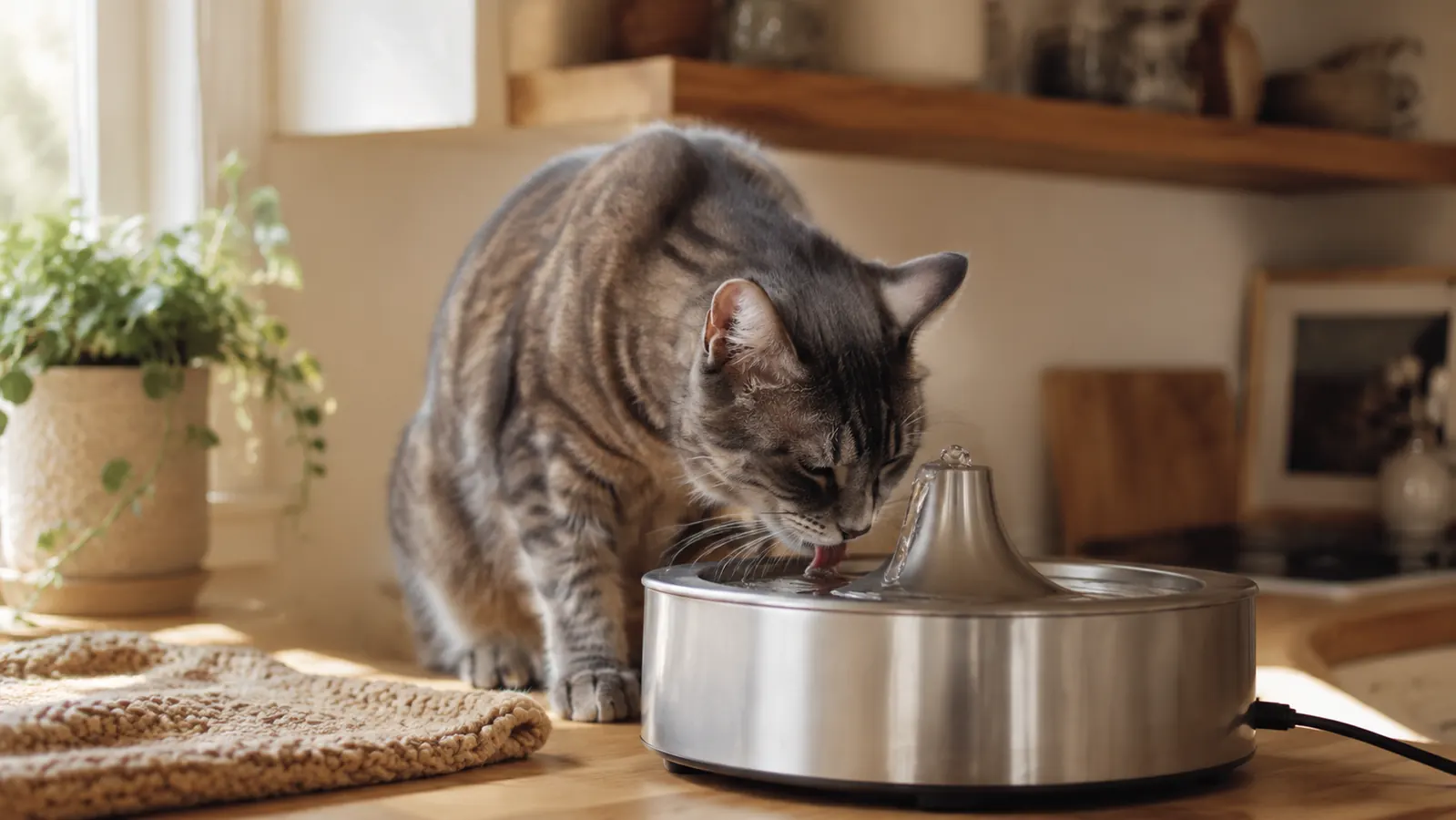
The single change that moved the needle for us was putting a real cat water fountain on the kitchen counter, specifically the FEELNEEDY stainless steel model that I will walk you through using below. When Marigold's vet flagged elevated urinary crystals at her 2024 checkup, the first thing she said was not 'change her food.' It was 'get her drinking more water.' I had always assumed Marigold drank enough. She walked to the bowl, lapped for a few seconds, walked away. Normal, right? Turns out cats are biologically inclined to get most of their moisture from prey, not from standing water, which means a bowl in the corner of the kitchen is genuinely working against their instincts. A domestic cat eating dry food and ignoring a still water bowl is not being difficult. She is just being a cat.
The good news is that increasing a cat's daily water intake is one of the more solvable problems in cat care, once you understand what actually drives drinking behavior. I went through this whole process with both Marigold (9-year-old gray tabby, 10 lbs, the planner) and Pip (4-year-old orange tuxedo, 12 lbs, chaos agent). These five steps reflect what worked, what failed, and the one tool that made more difference than anything else.
Your cat is probably dehydrated right now, and a still water bowl is not fixing it.
The FEELNEEDY 2.8L stainless steel fountain uses a continuous circulation pump to keep water oxygenated and appealing. The LED water level window means you never accidentally let it run dry. Rated 4.3 stars by nearly 2,000 cat owners.
Amazon Check Today's Price on Amazon →Step 1: Ditch the Plastic Bowl
Before you buy anything new, take a close look at what your cat is currently drinking from. Plastic bowls are porous at a microscopic level. Over time, bacteria and biofilm build up in tiny surface scratches, and cats can smell it even when you cannot. Many cats will drink less, or stop drinking altogether, from a plastic bowl that smells off to them. This is not finickiness. Their olfactory system is picking up something real.
Swap to stainless steel or ceramic as a baseline. Both are non-porous and easy to clean thoroughly. Stainless steel is the easier daily choice because it survives the dishwasher without glazing issues. If your cat has been slow at the water bowl and you have not replaced it in the past year, try a new stainless bowl for a week before adding anything else. Some cats show a noticeable increase in visits within 48 hours just from the material change.
One thing I learned from a crafty friend who fosters cats: wide, shallow bowls tend to work better than deep narrow ones. Cats dislike their whiskers pressing against bowl edges, a sensitivity called whisker fatigue. A wide stainless or ceramic dish with low sides removes that friction point entirely. It is a two-dollar solve for a problem most people miss.
Step 2: Multiply the Water Stations
One bowl in the kitchen is not enough for a multi-cat home, and it may not even be enough for a single-cat home. Cats are highly location-motivated when it comes to drinking. If the water is near the litter box, many cats will pass on it entirely. If another cat guards the main bowl (even passively, just by being nearby), a more submissive cat often goes without. In both cases, the fix is more stations.
I set up three water points in our house: the main fountain in the kitchen, a small ceramic bowl in the bedroom hallway, and a second ceramic bowl on the bathroom counter near Marigold's usual afternoon nap spot. Pip started using the hallway bowl almost immediately. He had been walking past the kitchen fountain without stopping, and I think it was because Marigold was often nearby. Location friction is real.
A general rule: one water station per cat, plus one extra, placed in different rooms and away from litter boxes by at least a few feet. Keep them elevated if you have older cats or cats with joint issues. Marigold, at 9, prefers anything she does not have to crouch too far to reach.
Step 3: Introduce a Running Water Fountain
This is the single highest-leverage step on the list. Cats are drawn to moving water by instinct. In the wild, still water can harbor bacteria. Moving water signals freshness. You can see this behavior any time a cat drapes herself over the bathroom sink waiting for you to turn on the tap. That is not a quirk. That is preference.
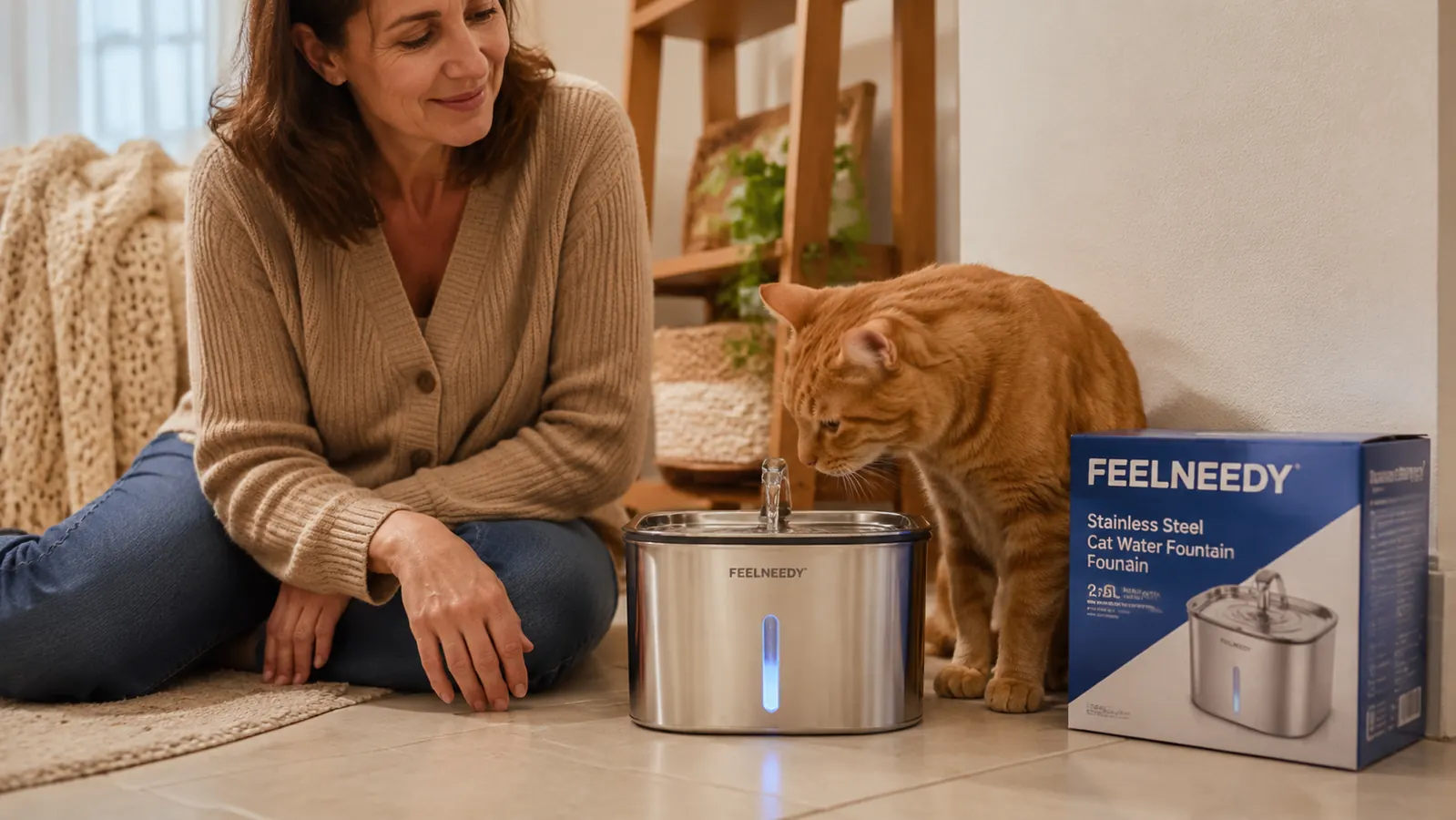
A continuously circulating fountain mimics running water well enough that most cats increase their drinking frequency within the first few days. The FEELNEEDY 2.8L stainless steel fountain is the one I bought after Marigold's vet visit, and it has held up well over four months. The pump is ultra-quiet, which matters more than I expected. I had tried a cheaper plastic fountain before this one, and the motor hum was loud enough that Pip refused to go near it. He is jumpy. The FEELNEEDY runs nearly silent on the counter next to the refrigerator.
The 2.8-liter capacity means I refill it every two to three days for two cats rather than daily, and the LED water level window tells me at a glance whether it needs topping up without me bending down to check. The stainless steel bowl and upper tray are dishwasher safe, which matters for hygiene maintenance. I run the bowl through a quick cycle every week.
One note on the transition: not every cat walks straight up to a fountain and starts drinking. Marigold used it within an hour. Pip took four days of the fountain being on before he would approach it. If your cat ignores it at first, leave it running in the same spot without moving it. The sound and sight of the moving water become familiar over a few days, and most cats come around.
The motor hum on my first plastic fountain was loud enough that Pip refused to go near it. The FEELNEEDY runs nearly silent on the counter next to the refrigerator. That one thing changed whether my 4-year-old would drink from it at all.
Step 4: Add Wet Food to the Rotation
Wet cat food is roughly 70 to 80 percent water by content. A cat who eats wet food even once a day is getting a meaningful portion of her daily moisture requirement through her meals without drinking a drop from any bowl or fountain. If your cat is currently on dry-only and you are worried about hydration, adding one wet meal per day is one of the most direct interventions available.
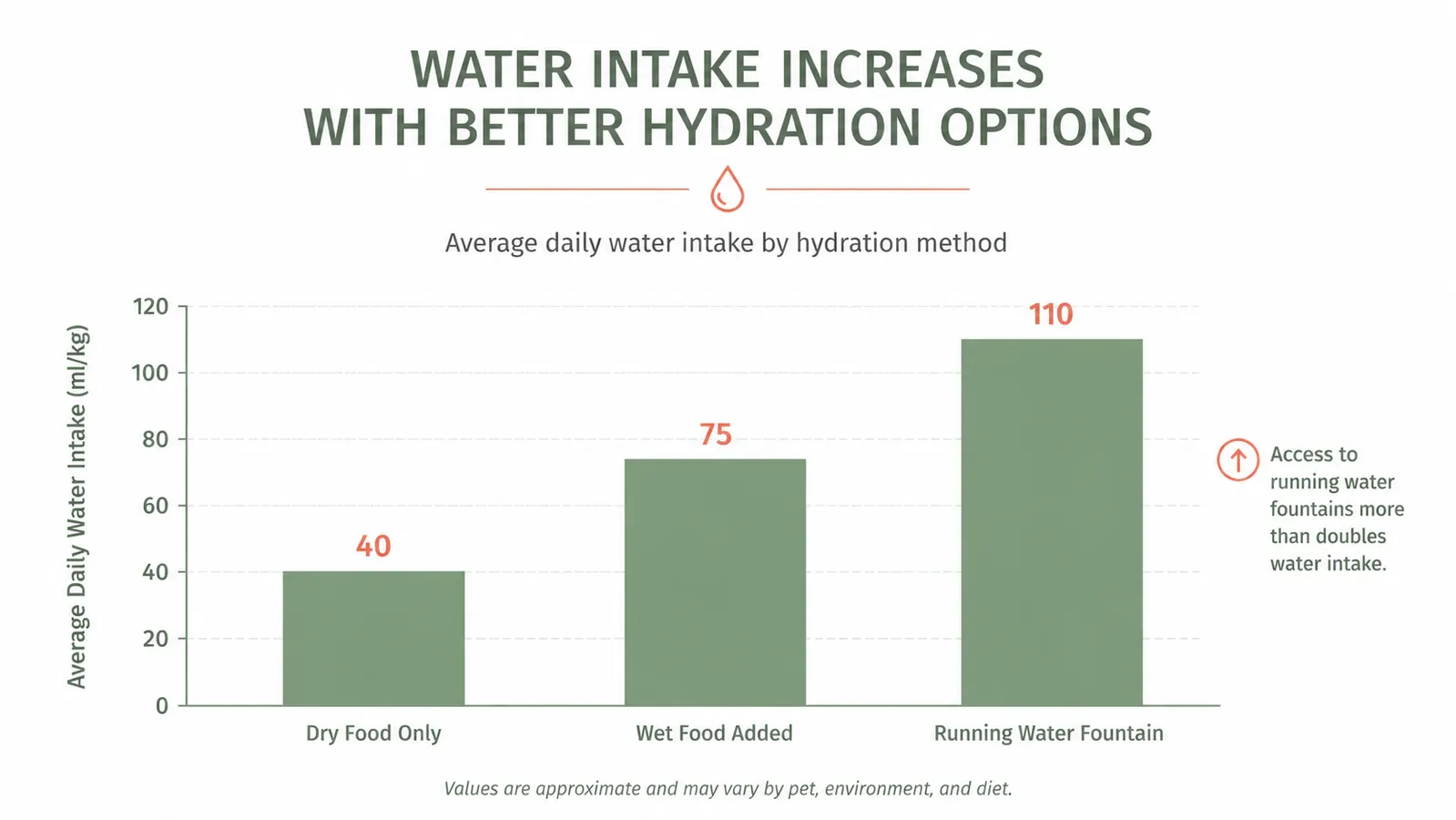
You do not have to overhaul your cat's entire diet to get the benefit. A small portion of high-quality wet food, even as a topper over dry kibble, adds measurable moisture to the daily intake. The exact amount matters less than the consistency. Cats do better when feeding schedules are predictable.
One workaround for cats who resist wet food textures: add a small amount of warm, low-sodium chicken broth to dry kibble. The smell and moisture both encourage more eating and incidental drinking. Marigold has been on a mix of prescription kibble and wet food since the crystal scare, and she cleans every bowl clean now where before she was leaving half.
Step 5: Manage Water Freshness Daily
Cats are more sensitive to the smell of stale or chemically treated water than most owners realize. Tap water sits in household pipes and collects chlorine and mineral content. To a human nose, it smells fine. To a cat, it can be off-putting enough to reduce drinking.
A few small habits make a real difference here. First, change still water bowls daily, not every few days. The water picks up room-temperature odors quickly. Second, if your tap water is heavily chlorinated, consider a simple filtered pitcher for filling the fountain and bowls. The carbon filter removes most of the chlorine smell. Some cats respond to this noticeably; others do not care. For a cat who is reluctant to drink even from a fountain, filtered water is worth a one-week test.
Third, rinse bowls before refilling rather than just topping them off. Biofilm accumulates even in a day or two, especially in warm kitchens. Running water through the bowl first removes the film and the smell that goes with it. It takes ten extra seconds and some cats reward it with immediately coming to drink.
For fountain maintenance specifically, the FEELNEEDY includes a filter that needs replacing every four to six weeks depending on your water quality and how many cats are using it. The replacement filters are inexpensive and easy to find. Staying on top of filter changes keeps the pump clear and the water tasting clean. A clogged filter reduces flow noticeably and can cause the pump to run louder, which may discourage shyer cats.
What Else Helps
A few smaller adjustments round out the picture. Water temperature matters to some cats: slightly cool water, not ice cold and not room-warm, tends to be most appealing. In summer months, dropping one small ice cube into a stainless bowl can increase visits from cats who like cold water. Some cats, notably Pip, will fish the ice cube out and bat it across the kitchen before drinking, but they still drink.
Location relative to food bowls is worth revisiting. In the wild, cats do not drink near their prey because blood and body fluids can contaminate water sources. Many domestic cats carry this instinct forward and prefer water stations placed a foot or more away from food bowls. Separating them slightly, even within the same room, can improve how often some cats choose to drink. I moved the kitchen fountain about two feet away from the food bowls and saw an immediate uptick in Marigold's fountain use.
For cats with known kidney issues, urinary crystals, or a history of UTIs, these steps are especially important but they are not a substitute for veterinary guidance. The goal here is improving baseline hydration in a healthy or mildly at-risk cat. If your cat is already showing symptoms or has an active diagnosis, work with your vet on a specific protocol.
If you want to go deeper on why running water makes such a difference physiologically, the article on reasons cats need a running water fountain covers the research behind feline hydration in more detail. And if you are trying to decide whether the FEELNEEDY is the right fountain for your situation, the full long-term review of the FEELNEEDY fountain covers four months of real use across two cats with different temperaments.
If your cat ignores her water bowl, a circulating fountain is the most direct fix available.
The FEELNEEDY 2.8L stainless steel fountain keeps water moving around the clock, holds enough for two cats between refills, and cleans up in the dishwasher. Nearly 2,000 reviews and a 4.3-star rating. Check today's price before you leave.
Amazon Check Today's Price on Amazon →