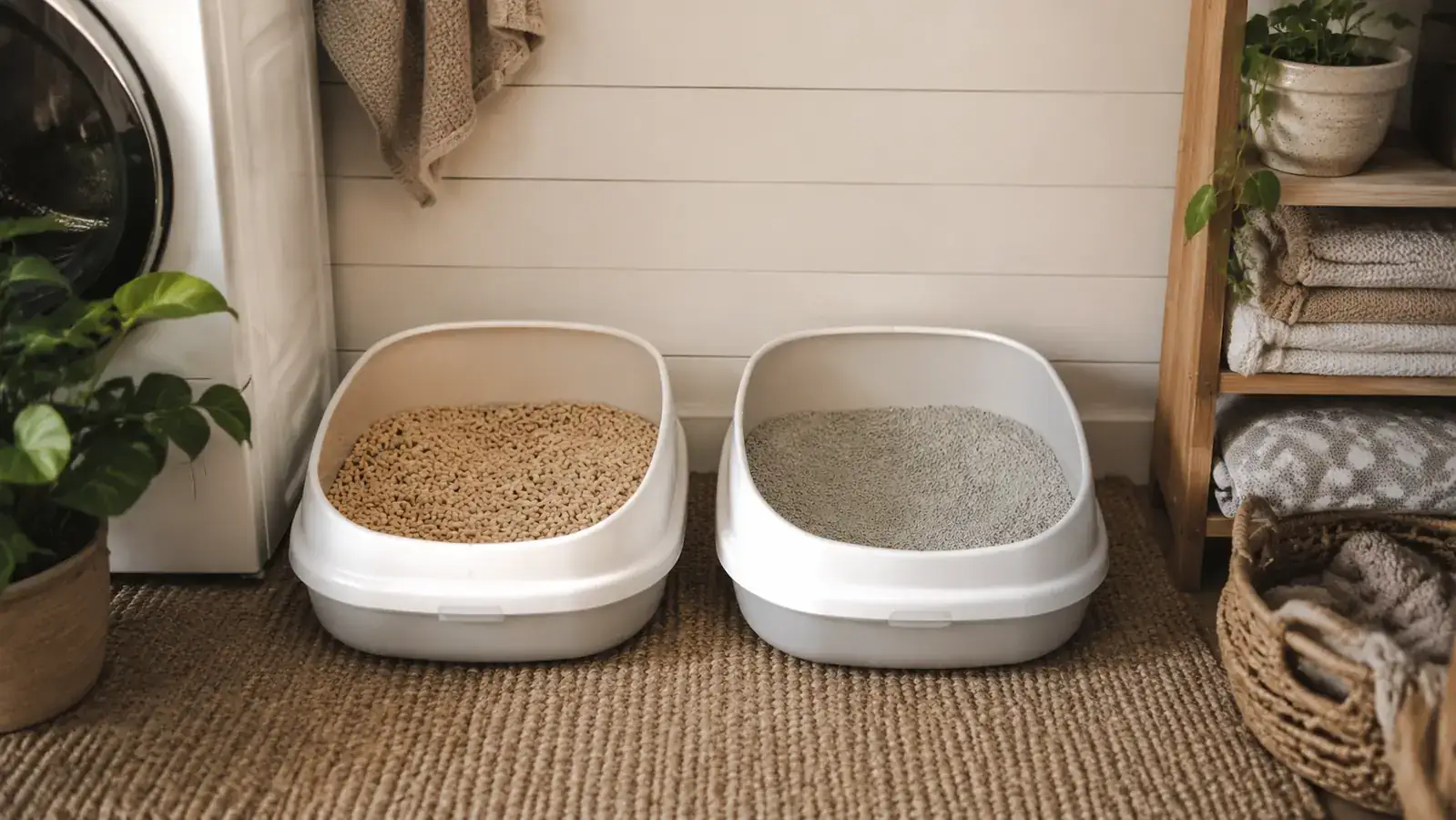
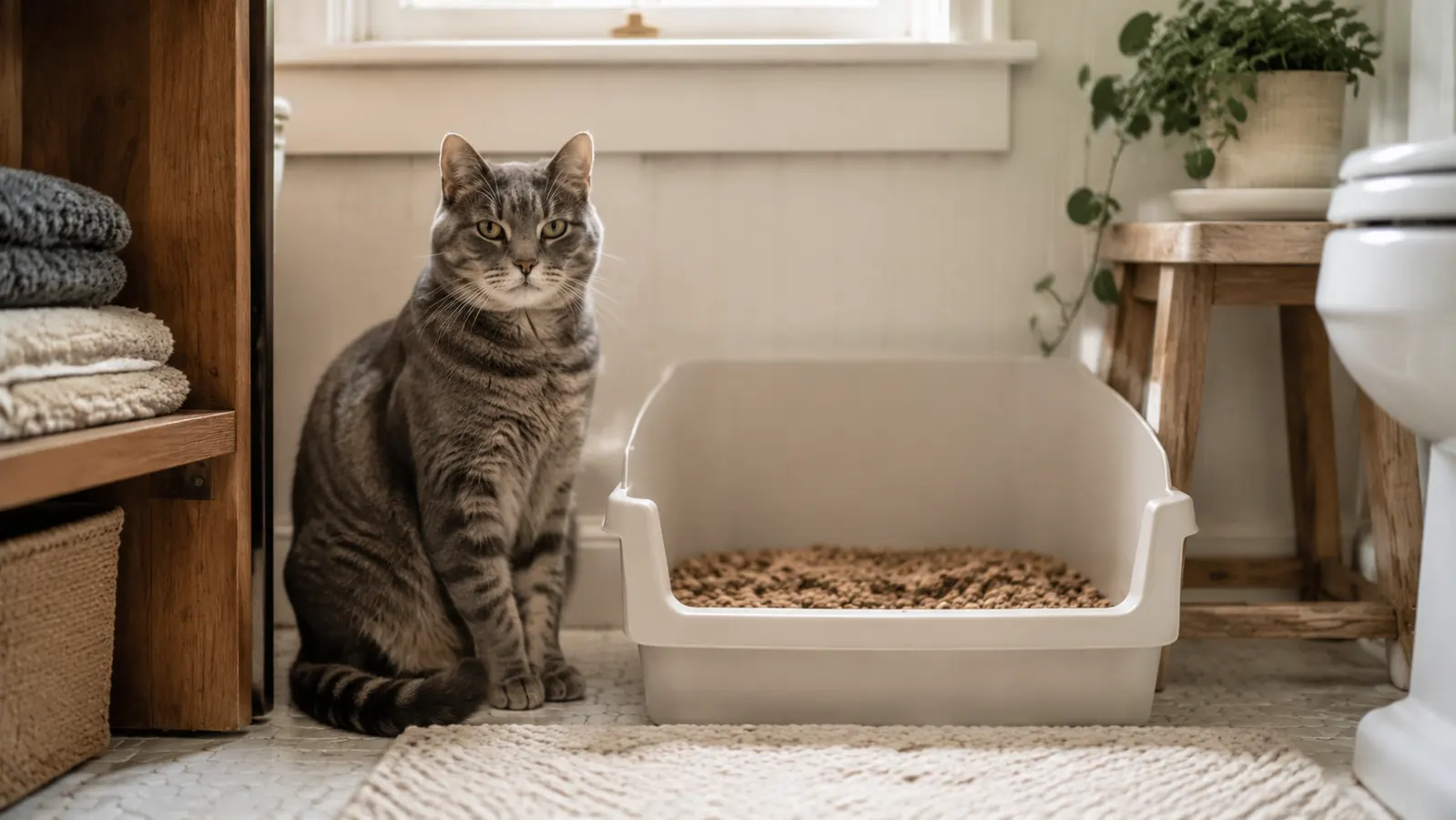
If you have used clumping clay litter for any length of time, you know the drill: the white film on the floor around the box, the gray dust cloud every time your cat digs, and that particular stale ammonia smell that creeps into the room by evening. I used clay litter for years before a friend suggested I try pine pellets. I was skeptical. My 9-year-old gray tabby Marigold is set in her ways and my 4-year-old orange tuxedo Pip has opinions about everything. Switching their litter felt like inviting drama. But I ran both types simultaneously for two months, one box per type, same room, and I now have a clear answer to which one actually works better for a multi-cat home.
The short answer is that Feline Pine Platinum came out ahead on odor control and dust by a meaningful margin. Clay won on familiarity and on the immediate clump-and-scoop convenience most cat owners are used to. Whether that convenience is worth the tradeoffs is what the rest of this comparison breaks down.
| Feature | Pine Cat Litter | Clay Clumping Litter |
|---|---|---|
| ~$21.85 | ~$14-18 depending on brand | |
| Pine neutralizes ammonia naturally on contact | Clumps seal odor until scooped | |
| Very low, minor sawdust when pellets break down | Moderate to heavy; fine silica clay dust on dig | |
| Minimal, pellets are large and heavy | High, fine clay particles cling and spread | |
| Scoop solids only; sawdust sifts to bottom tray | Full clump scooping is fast and familiar | |
| Works best with sifting box; standard box works but needs more maintenance | Any standard box works | |
| $8-12 per cat with sifting box efficiency | $12-20 per cat depending on usage | |
| 17 lb covers roughly one cat for 4-5 weeks | 18-20 lb goes faster with multiple cats | |
| Biodegradable pine, lower landfill load | Sodium bentonite clay, non-renewable, high landfill volume |
Your litter box should not be the smelliest corner in your home.
Feline Pine Platinum uses real compressed pine to neutralize ammonia at the source, not just mask it. Over 10,000 Amazon reviewers. Check today's price below.
Amazon Check Today's Price on Amazon →Where Feline Pine Platinum Wins
Odor control is the category that matters most for a multi-cat home, and it is where pine pulled the furthest ahead in my test. Pine naturally absorbs ammonia on contact through the wood itself. There is no chemical masking, no fragrance layering, no fake clean smell. When Marigold uses the pine box in the morning, I can walk into that bathroom thirty minutes later and barely notice it. The same was never true with clay. Clay traps odor inside a clump, which means the smell is contained only when the clump is undisturbed. Once Pip starts digging, the clay box broadcasts the smell freely. By hour six of a normal day, the clay box had a distinctly stronger odor than the pine box, consistently, across both months of testing.
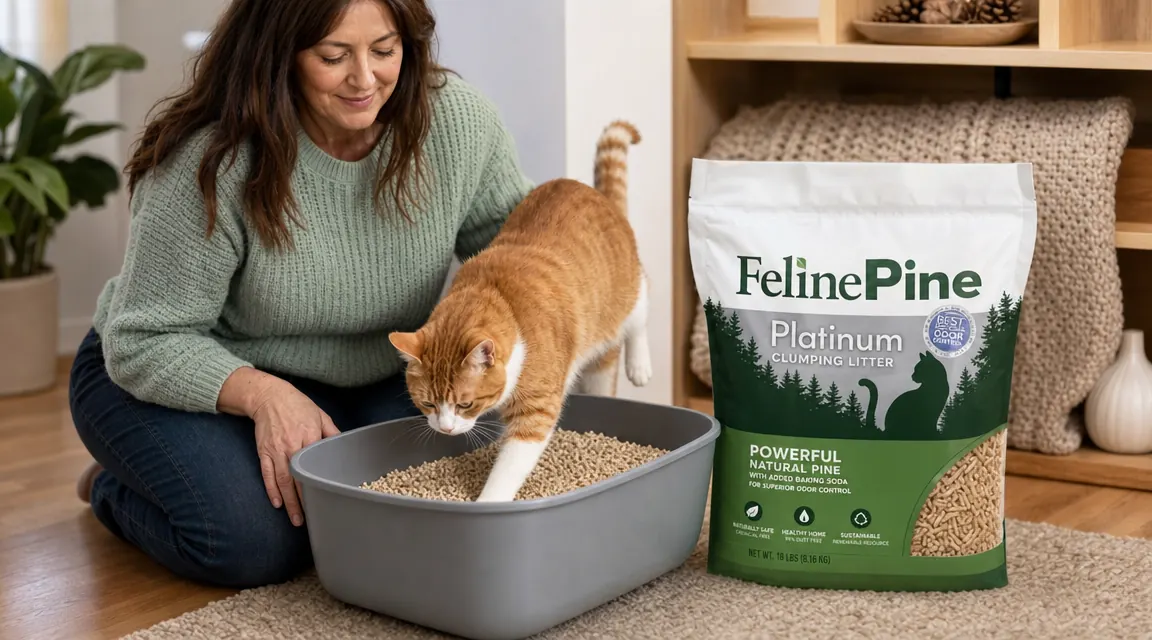
Dust is a close second. The clay box produced a visible dust cloud whenever either cat dug with any enthusiasm. I wiped gray film off the baseboard next to the clay box twice a week. With the pine box, the pellets themselves are large enough that digging does not kick particles into the air. The only dust-like material with pine is the fine sawdust that forms as used pellets break down, and that settles to the bottom tray rather than billowing into the room. For anyone with cats who have respiratory sensitivity or for households with allergy concerns, this difference is significant.
The clay box had a noticeably stronger odor by mid-afternoon every single day of the two-month test. The pine box did not. That is the whole story for odor control.
Tracking is another clear win for pine. Clay particles are fine and sticky. They travel. I found gray clay dust on the hallway rug six feet from the box every single day. With pine, the pellets are large and dense. They do not cling to paws or fur. I still swept occasionally because a stray pellet would roll out, but it was easy to spot and pick up. The floor around the pine box stayed dramatically cleaner. If your litter box is near a kitchen or main living area, this matters more than most reviews give it credit for.
Where Clumping Clay Wins
Clay litter has one major practical advantage: the clumping mechanism makes daily scooping fast and intuitive. You scoop the clump, you are done. There is zero ambiguity about what to remove. Most cat owners have used clumping clay since their first cat and have the routine down to two minutes a day. Switching to pine requires learning a new system, specifically the sifting box setup where liquid falls through to a lower tray and you scoop only solids. If you are not using a sifting box with pine pellets, you are making more work for yourself than necessary. The clay advantage here is really about familiarity and the immediate gratification of a clear clean-it mechanism.
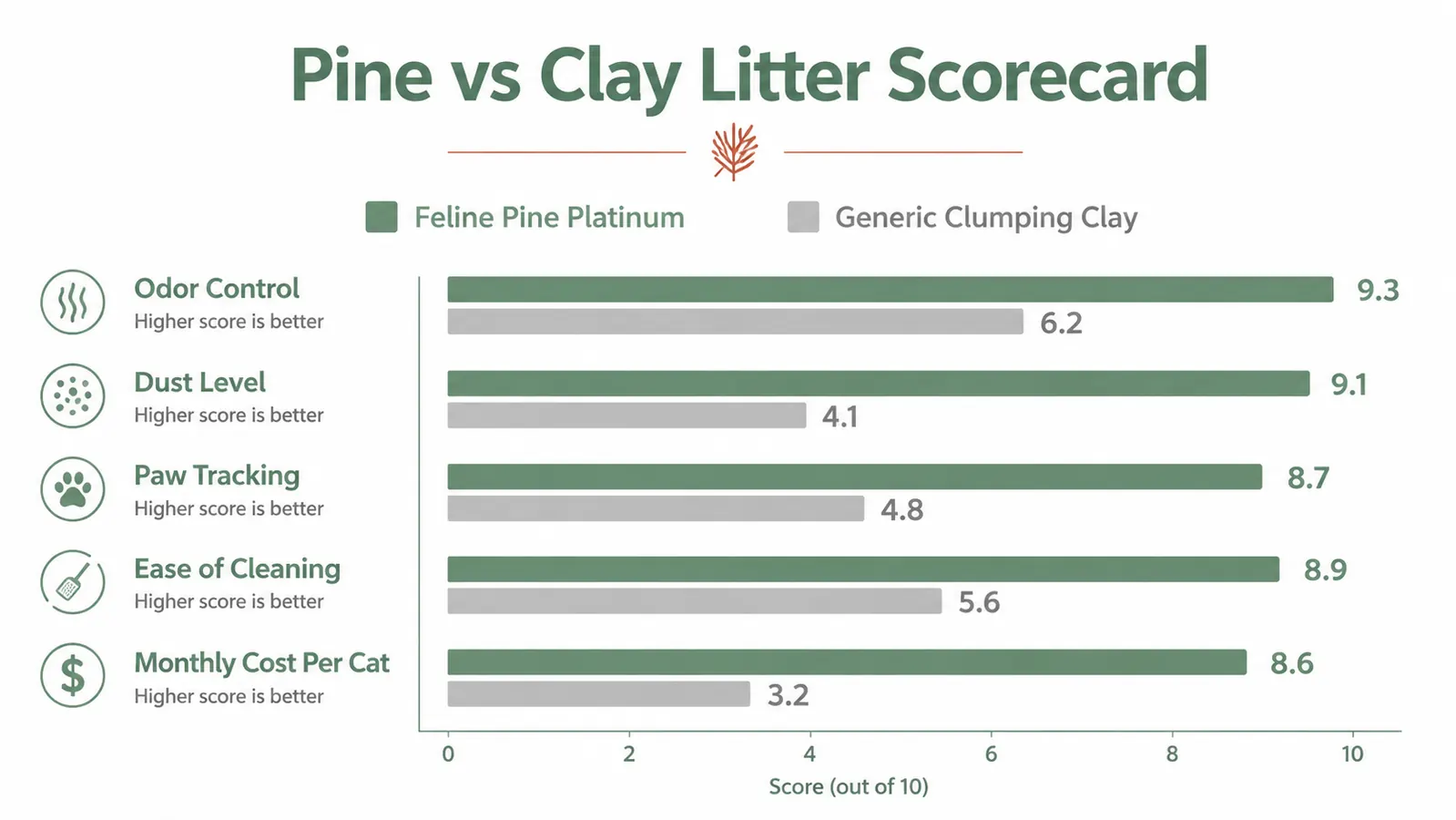
The upfront cost per bag is also lower for clay. A standard 18-pound bag of a name-brand clumping clay runs roughly $14 to $18 depending on the brand and where you buy it. Feline Pine Platinum at $21.85 for 17 pounds looks more expensive at a glance. The monthly cost per cat actually evens out or tips in pine's favor once you account for how long a bag lasts with proper sifting box setup, but if you are buying without a sifting box or if budget is the only variable on your list, the clay sticker price starts lower. I want to be upfront about that rather than pretend the pine pricing is a slam dunk.
Feline Pine Platinum is rated 4.3 stars across more than 10,500 Amazon reviews.
That is not a small sample size. Most reviewers specifically call out odor control and dust reduction as their reasons for staying with it after the switch.
Amazon Check Today's Price on Amazon →The Transition Problem (And How to Avoid It)
Pip rejected the pine box for four days before he started using it consistently. Marigold walked up to it, sniffed, and used it the first day. This is an honest data point. Cats are territorial about their litter box environment and some resist the change. The standard advice is to run both boxes in parallel during the switch so the cat has an option while adjusting to the new smell. That is exactly what happened here with my test setup, and Pip eventually transitioned fully. If your cat has strong litter box opinions, a cold-switch straight to pine may cause accidents. A two-to-three week parallel period removes most of that risk. For a full step-by-step transition guide, see the article on how to switch your cat to pine pellet litter.
The other thing worth knowing is that pine pellets break down when they absorb liquid. They go from a firm pellet to a soft sawdust. This is actually part of the design: the breakdown indicates the pellet has done its job and the sawdust sifts to the lower tray in a sifting box. But if you are not using a sifting box, you have a box full of mixed pellets and sawdust that is harder to manage. Feline Pine Platinum works well in a standard box, but it works significantly better in a sifting litter box. That is a $20 to $35 add-on cost to factor in if you do not already own one.
Monthly Cost Reality Check
I tracked actual usage for both boxes across two cats over eight weeks. With a sifting box and proper management, one 17-pound bag of Feline Pine Platinum lasted Marigold and Pip approximately 3.5 weeks between full box cleanouts. That works out to roughly $10 to $12 per cat per month. My clay usage ran closer to $16 to $19 per cat per month because I was going through bags faster and because clay is heavier so each bag contains less volume relative to its weight. Over a full year, the difference adds up. For a two-cat household, pine ran about $15 to $20 cheaper per month total than clay once the sifting box was in play. If you own three cats, that math improves further.
Who Should Buy Which
Feline Pine Platinum is the right choice if: odor control is your top priority, you or someone in your home has respiratory sensitivity to dust, you are tired of tracking gray paw prints across your floors, you want to reduce the environmental footprint of your litter habit, or you are willing to buy or already own a sifting litter box. It is also the better choice for multi-cat households simply because the cost efficiency improves with scale and the odor neutralization holds up better under higher box traffic than clay does.
Standard clumping clay makes sense if: your cats are very resistant to change and you cannot manage a parallel transition period, you do not want to invest in a sifting box, or you are doing short-term fostering where box continuity matters more than optimization. Clay is also still fine for a single-cat household where you are scooping twice daily and doing full box changes every week. The problems with clay compound with cat count and with scoop frequency. If you are on top of it daily, clay performs reasonably.
For my household, Feline Pine Platinum is now the permanent setup in all three litter boxes. Marigold uses it happily and Pip has been fully converted. The pine smell in the bathroom when I first open a new bag is pleasant rather than antiseptic, and the day-to-day odor difference compared to what I lived with under clay is noticeable enough that I would not go back. For more detail on six months of daily use with multiple cats, read the full Feline Pine Platinum long-term review.
Cheaper per month, lighter tracking, dramatically less dust: Feline Pine Platinum wins the comparison on three out of five factors.
If you have been thinking about making the switch, check today's price on Amazon and see if it fits your box routine.
Amazon Check Today's Price on Amazon →