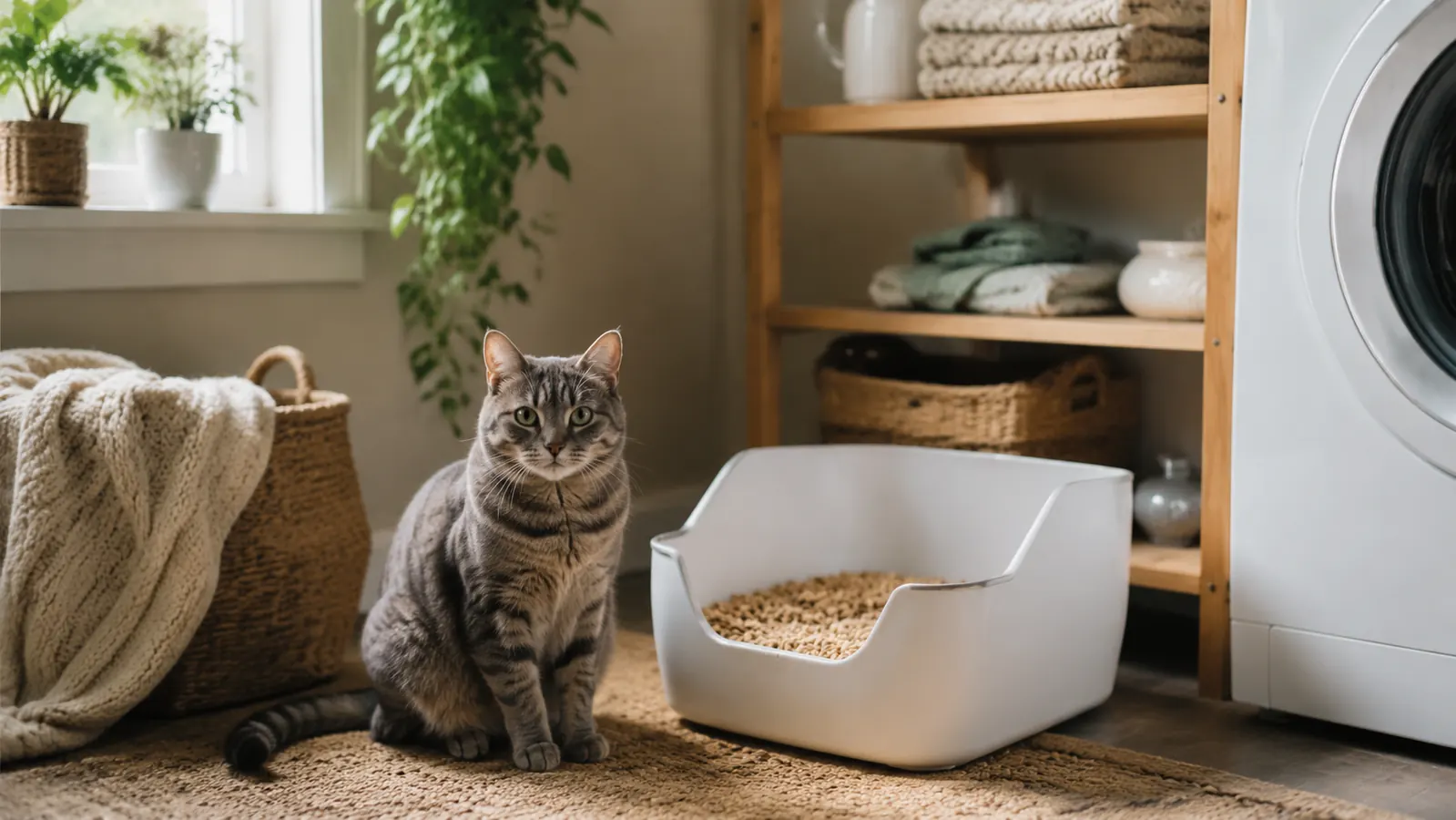
My laundry room used to smell like a litter box no matter what I did. I am not being dramatic. I had three cats using two clay clumping boxes in there, and by the time my 9-year-old gray tabby Marigold had her second urinary episode in the spring of 2024, my vet and I started talking about everything in her environment, including what she was digging through four times a day. Dust was a real concern. So was the fact that I was going through a 40-pound jug of clay clumping litter every three weeks and still losing the odor battle by day four of a fresh fill.
I switched all three boxes to Feline Pine Platinum Non-Clumping Litter in November 2024. My youngest, a 4-year-old orange tuxedo named Pip, accepted it the same day. Marigold took about a week and a half. Six months in, I have not gone back to clay, and I do not plan to. But this is not a straight love story. There are real trade-offs you need to understand before you commit, especially if you have a picky cat or a covered box setup.
Quick Verdict
Genuine odor control upgrade over clay with near-zero dust, but the sawdust management requires a specific routine and cats with texture preferences may take two weeks to accept it.
Amazon Check Current Price on Amazon →If your litter box smells by day three, clay is not your friend. See today's price on Feline Pine Platinum.
Feline Pine Platinum is the non-clumping pine pellet litter backed by Arm & Hammer odor control. Over 10,000 Amazon reviews, currently sitting at 4.3 stars. The 17 lb bag runs households of one to three cats for roughly four to six weeks depending on how you manage the sawdust.
Amazon Check Today's Price on Amazon →How I Set Up and Used It Over Six Months
I run three litter boxes total: one open rectangular box in the laundry room that Marigold has always preferred, one covered box in the hallway bathroom that Pip claimed immediately when we brought him home, and a second open box in the spare room that serves as the neutral territory box during any inter-cat tension. When I made the switch, I filled all three at once rather than doing a gradual blend. Some people recommend blending, but Marigold is already sensitive to any formula changes in her food and I did not want to draw out the transition. Cold turkey on the litter worked here, though your results may vary.
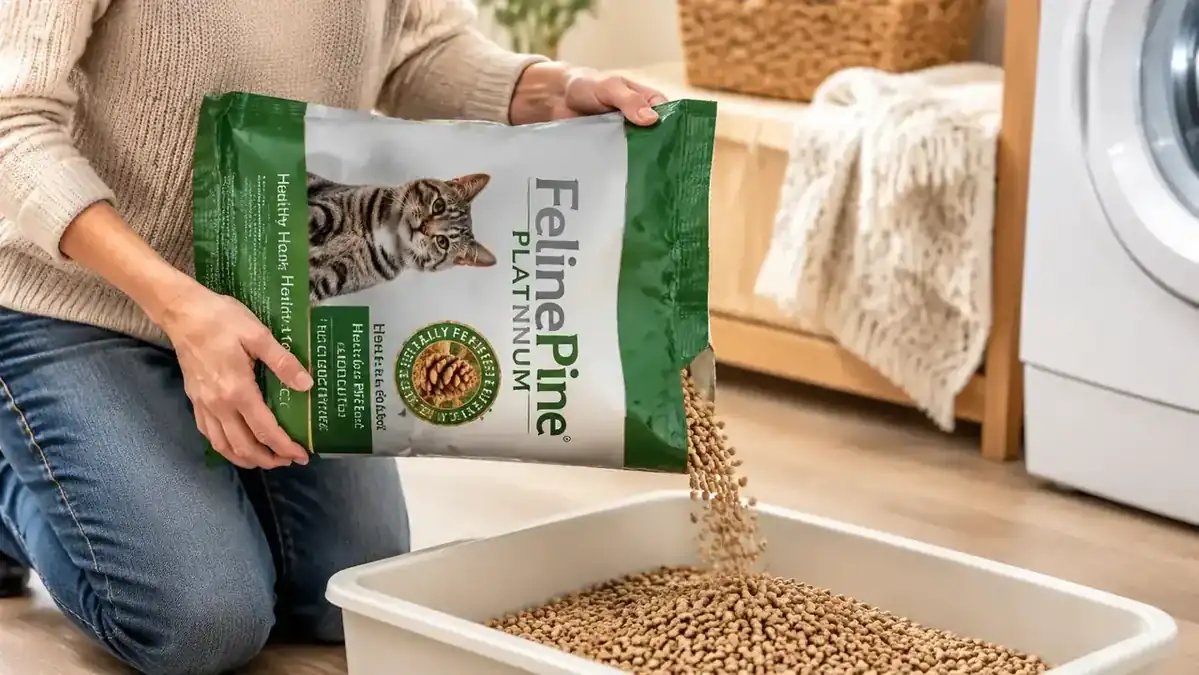
The first thing I noticed was the smell, or rather the lack of a specific smell. Fresh pine pellets have a gentle natural cedar-and-pine scent that fades in a few days. What replaces it is basically nothing, which is the point. The Arm & Hammer baking soda in the Platinum formula is doing real work on ammonia. Six months in, the laundry room no longer announces itself when I open the door. The hallway bathroom, which had always been the problem child box because it is covered and retains more heat, is also manageable now in a way it never was with clay.
The routine I landed on: I scoop solid waste daily with a standard slotted scoop, which lets the spent sawdust fall through while I remove solids. Every four to five days I sift the whole box to push sawdust through to the bottom layer. Full box change every three weeks, though boxes with heavier use like the laundry room box get refreshed at two and a half weeks. One 17 lb bag has been getting me through roughly 35 days across all three boxes with this schedule. That tracks with the typical usage estimates you will see on the bag.
The Odor Control Reality Check
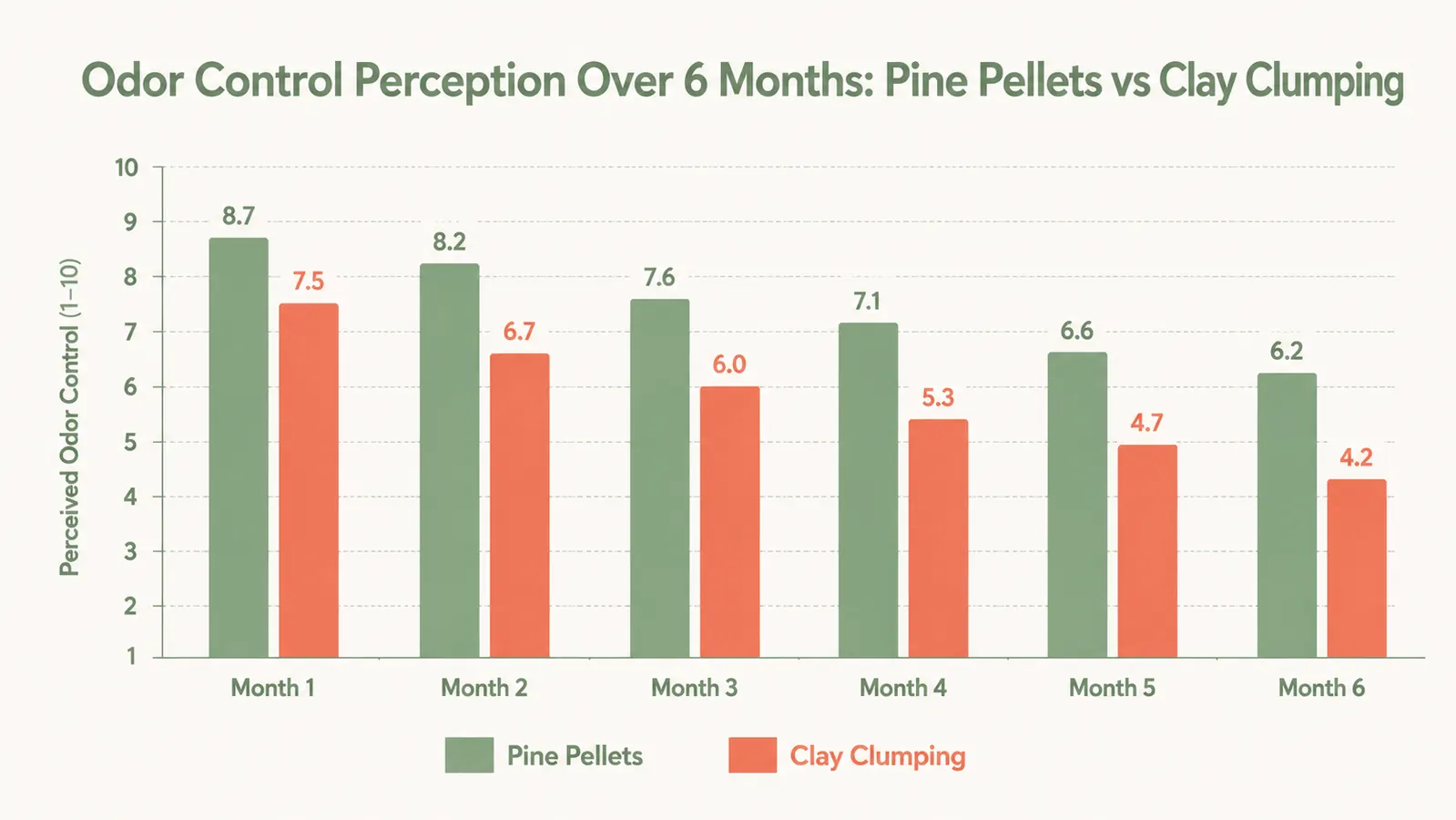
Clay clumping litter does a fine job controlling odor for the first 48 to 72 hours after a fresh fill, and then it degrades fast. The urine clumps start breaking down, the clay dust mixes with moisture and creates a background ammonia haze, and by day four the box smells the way litter boxes smell in movies about people who have too many cats. Feline Pine Platinum works on a fundamentally different mechanism. When a cat urinates, the pellets absorb the liquid and break down into sawdust. The pine and the baking soda work together to absorb ammonia before it has a chance to off-gas into the room.
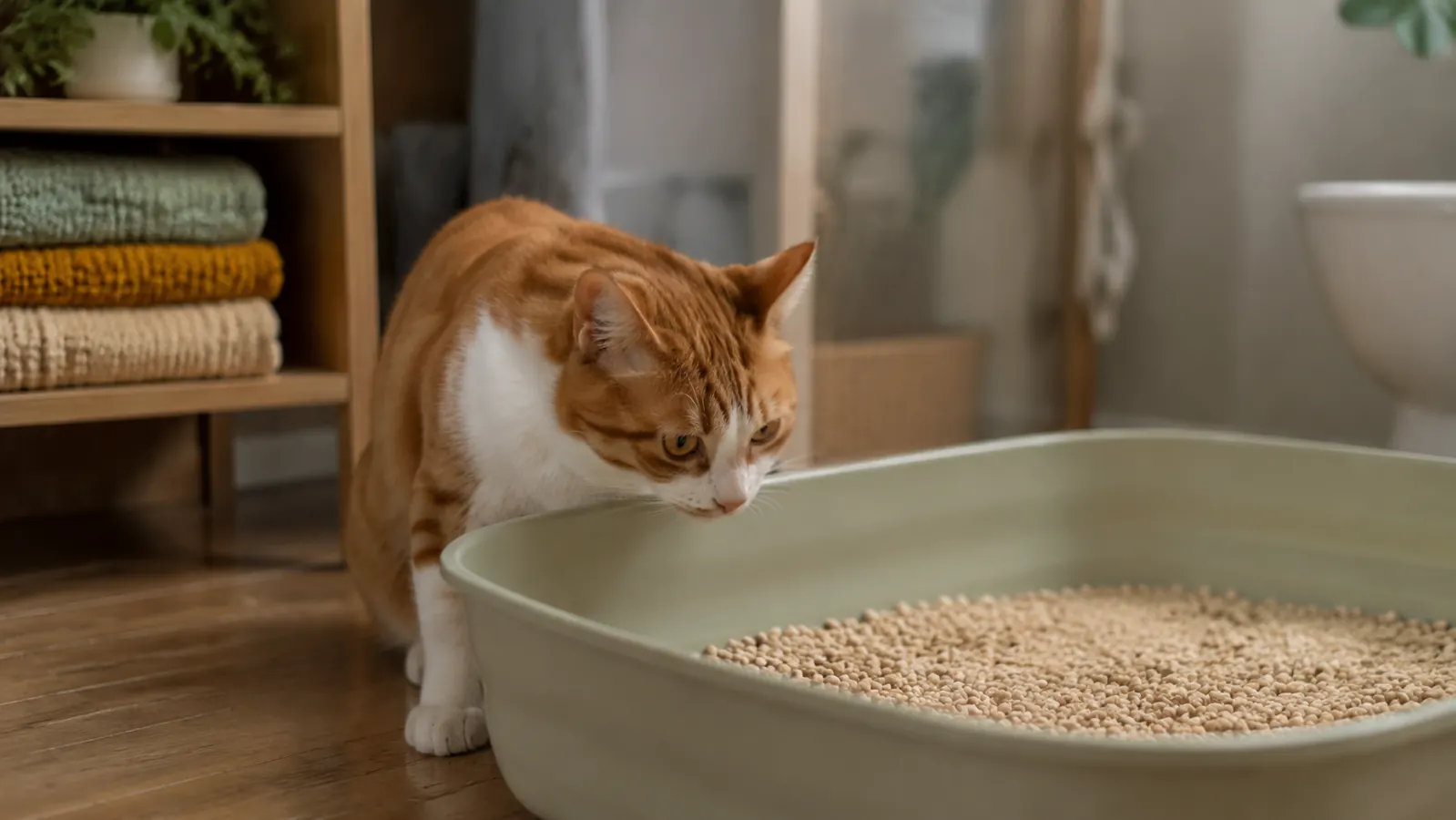
In practice this means the odor control does not peak at day one and decay from there. It stays consistent until the sawdust layer gets deep enough that the pellets sitting on top can no longer do their job. That point is around the two-to-three-week mark in my setup. I never get the mid-cycle stink spike I used to dread with clay. The downside is that solid waste smell is not masked at all by the pine. You will need to scoop daily or you will notice it. Daily scooping is good practice regardless, but if you were ever counting on your clay clumping litter to buy you an extra day, pine pellets do not offer that same forgiveness.
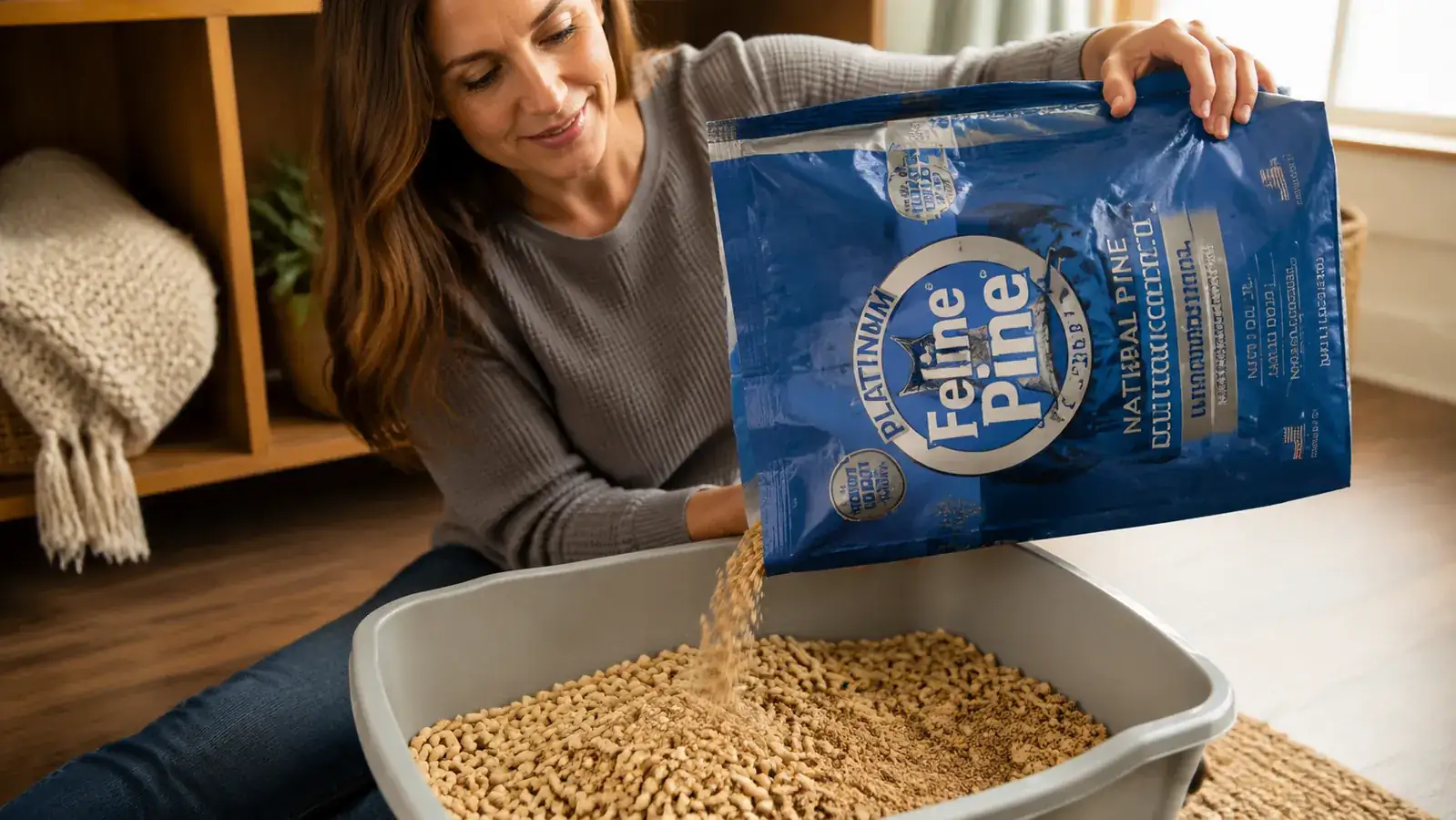
The laundry room no longer announces itself when I open the door. Six months in, that still surprises me a little.
The Sawdust Problem: What Nobody Covers in Short Reviews
Here is the thing about Feline Pine that the three-sentence reviews gloss over: the spent sawdust accumulates at the bottom of the box, and if you do not have a system for it, it will bother you. The pellets are doing exactly what they are designed to do when they break down, but the result is a layer of fine brown powder sitting under your intact pellets. If you scoop regularly and stir, the sawdust stays at the bottom and does not impair the litter's function. But if you ignore it, the sawdust layer gets deep enough that the intact pellets are essentially floating on top of spent material and your odor control suffers.
There are two approaches that work. The first is a two-sifter box system, which some Feline Pine devotees swear by: you run two stacking sifting boxes and tip the sawdust out the bottom while the intact pellets stay in the upper tray. It is elegant and reduces how often you do full box changes. I tried it and personally found the tray-stacking process annoying when my hands were full, so I abandoned it. The second approach, which is what I do, is just a regular daily scoop for solids plus a deliberate weekly stir to check sawdust depth. When the sawdust layer reaches about an inch at the box corners, I do a partial refresh, adding a cup or two of fresh pellets and scooping out the sawdust separately before it gets dense. It takes about four extra minutes per box per week. I find that completely reasonable for the odor payoff.
Dust Levels and What That Meant for Marigold
This was the primary reason I made the switch and it delivered immediately. Clay clumping litter generates a fine dust cloud every time a cat digs, covers, or even just steps into the box. If you have ever watched the morning light through your laundry room window, you have seen it. Marigold has been prone to upper respiratory inflammation since she was about six, and I cannot prove causation, but the vet and I agreed that reducing airborne particulate around her boxes was worth trying. In six months on pine pellets, I have not had a single episode requiring a vet visit for respiratory issues. That may be coincidence. I am taking it as a data point.
The pine pellets themselves produce almost no dust when poured or when a cat digs. They are dense enough that digging behavior does not spray fine particles. What you do get occasionally is a small amount of sawdust on the paws when a cat exits, which tracks onto the floor around the box. It is nowhere near the volume of clay tracking I was dealing with, and a small mat in front of each box catches most of it. Pip, who is an enthusiastic digger and treats the litter box like he is excavating an archaeological site, leaves almost nothing on the bathroom floor now. With clay he was leaving a half-ring of gray powder on the tile every time.
Cat Acceptance: What Marigold's Two-Week Holdout Taught Me
Pip walked into the new pine pellet box the first evening, used it without drama, and has never looked back. He is four years old, has never known anything but the boxes I provide, and seems content to go along with changes. Marigold is another story. She stood at the edge of the laundry room box for the first three days, sniffed the pellets, and then went to find the old box that no longer existed. She held out by going less frequently, which I was monitoring carefully given her history. I put a thin layer of her old clay litter on top of the pine pellets as a bridge, which did not excite her but seemed to lower the threshold enough for her to commit.
By day ten she was using it consistently and by day fourteen I removed the clay top layer entirely. Now she digs in it with the same focused determination she brings to everything. What I learned from Marigold's transition is that the texture shift is real for cats who have only known clumping clay. The pellets feel completely different underfoot, they make different sounds when disturbed, and the smell is different. Patient cats figure it out. Anxious cats may need the gradual blend method, which I cover in more detail in the full transition guide. If you have a cat who has previously rejected substrate changes, budget three weeks and do the 75/25 blend approach.
Covered Box vs Open Box Performance
I want to flag this because I do not see it discussed often. The covered box in my hallway bathroom performed noticeably worse than the open boxes during the first month, and I initially attributed this to Pip's usage patterns. What I eventually figured out is that the covered box traps heat and humidity, which slows the pine's ability to off-gas absorbed ammonia. Open boxes vent naturally; covered boxes do not. Once I started leaving the covered box door flap partially open and added a carbon filter pad inside the hood, the performance evened out. If you run covered boxes and switch to pine pellets, plan for this and give your setup an adjustment period. The litter is not failing; the airflow is.
Cost Over Six Months Compared to Clay
I was spending roughly $60 to $65 every three weeks on a 40-pound jug of clumping clay for three boxes. At that pace, my annual litter spend was approaching $1,100. With Feline Pine Platinum at current pricing, one 17 lb bag runs me about five weeks across three boxes. The math on pine pellets works out considerably more favorably when you account for the volume-to-coverage ratio, because pellets are less dense than clay and a pound of pellets covers more box surface than a pound of clay. I am spending meaningfully less per year on Feline Pine than I did on clay, and I am hauling lighter bags. Both things matter when you are managing three boxes in a two-story house.
Pros
- Odor control stays consistent for two to three weeks rather than fading after day three
- Near-zero dust compared to clumping clay, measurable difference in air quality around boxes
- Lighter weight per bag versus equivalent clay coverage
- Lower cost per week of coverage once you have the routine dialed in
- Natural pine scent on fresh fill is pleasant and not synthetic
- Arm & Hammer baking soda formula handles ammonia noticeably better than basic pine pellets
Cons
- Sawdust accumulation requires active management or odor control degrades
- Picky cats with texture preferences may need two to three weeks to accept the substrate change
- Solid waste smell is not masked at all, daily scooping is non-negotiable
- Covered boxes need airflow modification to perform on par with open boxes
- Non-clumping format means you cannot track individual cat output the way you can with clumping
Who This Is For
Feline Pine Platinum makes the most sense for households where dust is a real concern, whether that is a cat with a respiratory history like Marigold or a human with allergies or asthma. It is also the right call if you are tired of the clay odor decay pattern and want something that performs evenly across the full cycle rather than brilliantly on day one and badly by day five. Multi-cat households benefit from the cost and weight efficiency once you figure out the sawdust management routine. If you want to dig into the full picture of how pine pellets compare to clay on every dimension, the side-by-side breakdown in my comparison article covers it in detail.
Who Should Skip It
If you have a cat who has repeatedly rejected non-clay substrates and has a history of inappropriate elimination during any litter transitions, I would approach the switch very cautiously. The texture and smell change is significant enough that a cat with elimination anxiety could interpret it as a reason to find somewhere else to go. The gradual blend method helps, but it is not a guarantee. Also, if you love the convenience of clumping litter for monitoring output, pine pellets will not give you that. The sawdust tells you something happened, but not how much. For households with cats on urinary monitoring protocols, that data loss matters. For context on the full range of reasons pine litter has advantages and where clay still wins, the reasons article is worth reading before you commit to a full switch.
Ready to give your litter room a real odor reset? Feline Pine Platinum is what I use every day across three boxes.
Over 10,000 Amazon reviews, 4.3 stars, and about five weeks of coverage per 17 lb bag for a three-cat household when you manage the sawdust the right way. If you have been fighting that mid-cycle clay smell for years, this is the change worth making.
Amazon Check Today's Price on Amazon →